CONTINUATION
U.S. Navy Yard New York
Dec 24th 1835Sir, Acting under the principles that govern all, I most respectfully ask that the daily pay allowed to me as Master Painter of this Yard may be raised –
My reasons for making this request are many and obvious: the prices of all Mechanical Labor have advanced at least one third; every article required for sustenance and comfort have risen almost one half more than they were twelve months since, that the pay allowed to the Master Painters of the principal Yard is much greater than has ever been sanctioned at this (the one at Boston I understand receives $ 3.25 per diem) that the Navy Commissioners appear disposed from what they have already done, to allow a fair compensation for services rendered, and that $ 2 per day, the Sum I now receive, is not an equivalent for my labor or sufficient to support my numerous family –
I will at this time take the liberty of informing you that my duties are not only confined to Ship & House painting but to Gilding, Painting Flags of Foreign powers which cannot be executed in any other manner, and to all the various branches of an ornamental painter, and which feel satisfied I am capable of performing – This subject has never yet been brought before you, and which my desire not to encroach upon your time, has prevented me from presenting long ever this, but stern necessity compels me to solicit the favor of an increase in my pay, so as to place me in a situation equal to those holding similar situations at the principle Navy Yard of the United States, thereby enabling me to do justice to those who look up to me for support.
Relying with confidence on your liberality, I hope that this request will meet with your approbation and approval.
I have the honor to be Sir, Your most obedient Servant
[Signed] Isaac Reynolds
Commodore Charles G. Ridgley
Commanding U.S. Navy Yard
New YorkMore than 500 Laborers have been lately discharged
Source: Centinel of Freedom 27 February 1838, p.2.
More than 500 laborers have been lately discharged from the Brooklyn Navy Yard, in the inclemency of the winter. It is stated by them that more than half have been unnecessarily discharged. The "Brooklyn Soup House Association", daily distributes charity to hundreds of the sufferers thus abandoned to the rigors of winter. Again, we would ask what has this people – worshiping Administration done for the poor. Was their condition ever so bad under any other Administration?
Brooklyn Navy Yard Station Log for Christmas Day, 25 December 1839 and New Years, Day 1 January 1842
Source: NARA Record Group 45 entry 456 of the original New York (Brooklyn) Navy Yard Station Log.
Note: This entry for 25 December 1839 is one of the earliest surviving BNY station log entries. Typically the BNY station log states the number of personnel employed, the number of mechanics in various trades, laborers at work on a given date, and reports of work accomplished. Many entries list the name of the naval and merchant vessels at the yard, the name of the ship’s captain, and the reason for a visit such as delivery of supplies or repair. Steam engines to power the foundries and mills were introduced and became a regular part of the work environment by the Civil War. The arrival of steamboats, both naval and merchant, was common. Many of these vessels were loaded with coal and reflected the navy yard shift away from building wooden ships to Steam vessels. Increasingly anthracite coal rather than wood was the fuel for large foundries and steam engines.
Watch officers were also obligated to chronicle the weather with particular attention to wind direction and cloud formation; log entries from the 1830’s include the air temperature and barometric pressure. Changes in weather were crucial since most mechanics and laborers worked out of doors. The nineteenth century shipyard workforce was largely composed of per diem workers. The practice at Washington and other federal shipyards was to retain only the absolute number of these men necessary for a given shop to operate or complete a ship repair. Accurate weather observations were useful in projecting the number and types of workers required. Cold weather meant that laborers unlike carpenters, painters, and blacksmiths who could work indoors in a shop or shed would be laid off until warmer weather made their work feasible.Remarks of the U.S. Navy Yard New York
James Renshaw54 Esqr, Commandant & Silas H. Stringham55 Esqr, Commander
Remarks Wednesday December 25th 1839Commences with clear pleasant weather wind North, at 11.30 A.M. the Schooner Wave returned to the Yard from the Railway of Mr. Whiting. The Mechanics and Laborers were not mustered during the day nothing usual occurred. Ended with thick Fog & Calm.
T. Bailey Lt. of the Watch.
54. Renshaw, James. Midshipman, 7 July 1800. Lieutenant, 25 February 1807. Master Commandant, 10 December 1814. Captain, 3 March 1825. Died 29 May 1846.
55. Stringham, Silas H. Midshipman, 15 November,1809. Lieutenant, 9 December 1814. Master Commandant, 3 March 1831. Captain, 8 September 1841. Retired List, 21 December 1861. Rear Admiral on Retired List, 16 July 1862. Died 7 February 1876.
Remarks of the U.S. Navy Yard New York
Matthew C. Perry Esqr, Commandant56 & Joshua R. Sands Esqr, Commander
Saturday January 1st 1842.These 24 hours commenced clear, wind has been moderate from South West with clear mild weather till 4 P.M., then passing clouds to the end –
Sailed from the Yard at 1.30 P.M. the sloop Venus-The Mechanics & Laborers employed in the Yard were not mustered at 1 P.M. this being considered a kind of Holiday beginning the New Year.
The Officer of Police Inspected the Yard, Buildings & Vessels, and after sun set took the circuit of the Yard, visited each watch station, saw all light & fires extinguished and all safe, the watchman attentive and vigilant -
Total Mechanics, laborers &c employed in the Yard . . . . 538
9 A.M. January 2nd
C. H. Jackson Lt. of Police.56. Commodore Matthew Calbraith Perry, April 10, 1794 to March 4, 1858, United States Navy and commanded a number of ships. He served in several wars, most notably in the Mexican-American War and the War of 1812. He played a leading role in the opening of Japan to the West with the Convention of Kanagawa in 1854. Perry was very concerned with the education of naval officers and helped develop an apprentice system that helped establish the curriculum at the United States Naval Academy. With the advent of the steam engine, he became a leading advocate of modernizing the US Navy and came to be considered "The Father of the Steam Navy" in the U.S. He spent the years 1833-1837 as second officer of the New York Navy Yard.
The Case of Mr. Dean
Source: Long Island Star Long Island, New York, 25 July 1840, p. 2.
Brooklyn Navy Yard the case of Mr. Dean, who was removed from the situation of Master Painter at the Navy Yard on account of his politics, is at this time attracting the attention of the citizens of Brooklyn. There are spies and meddling men connected with the Navy Yard, who require every master mechanic to select his under workmen with particular reference to his political vote. It is not sufficient that the master is neutral, indifferent or passive, as he may in that case unfortunately employ Whigs without his knowledge! It is required that he should be positively useful to the party in his selections.
Workers not paid
Source: Augusta Chronicle, Augusta, Georgia, 1 August 1840, p.,2.
The New York Courier states, upon good authority, that the "Riggers, Carpenters, Caulkers &c. at the Brooklyn Navy Yard have not for the past six weeks received a cent of pay for their services." Shame on the government that will not pay the hard earnings of the industrious mechanic.
Fatal Casualty at the Navy Yard
Source: Augusta Chronicle, Augusta Georgia, 3 March 1841, p3.Source: Commercial Advertiser New York, New York, 14 August 1840, p. 2.Daniel James aged about 40 years, a ship carpenter employed on the new steam frigate in progress at the Navy Yard Brooklyn fell from the upper deck to the hold by which his neck was broken and instant death produced. He left a family, to which his wife added another child yesterday morning, but a couple hours before her husband was killed. A subscription for the benefit of the family was immediately opened in the yard, and we are gratified to hear that it bids fair to amount to something handsome.
Commodore Renshaw Removed
Source: Augusta Chronicle, Augusta Georgia, 3 March 1841, p3.
Correspondence from the National Intelligencer, New York, February 25.
It is currently reported here that Com Renshaw has been removed from the station at the Brooklyn Navy Yard and Commodore Nicholson appointed in his stead. The charge preferred against Commodore Renshaw, it is said, was that he allowed the workmen in the Navy Yard only a half day to attend the polls.5757. Commodore James Renshaw Commandant BNY 9 November 1839 to 12 June 1841.
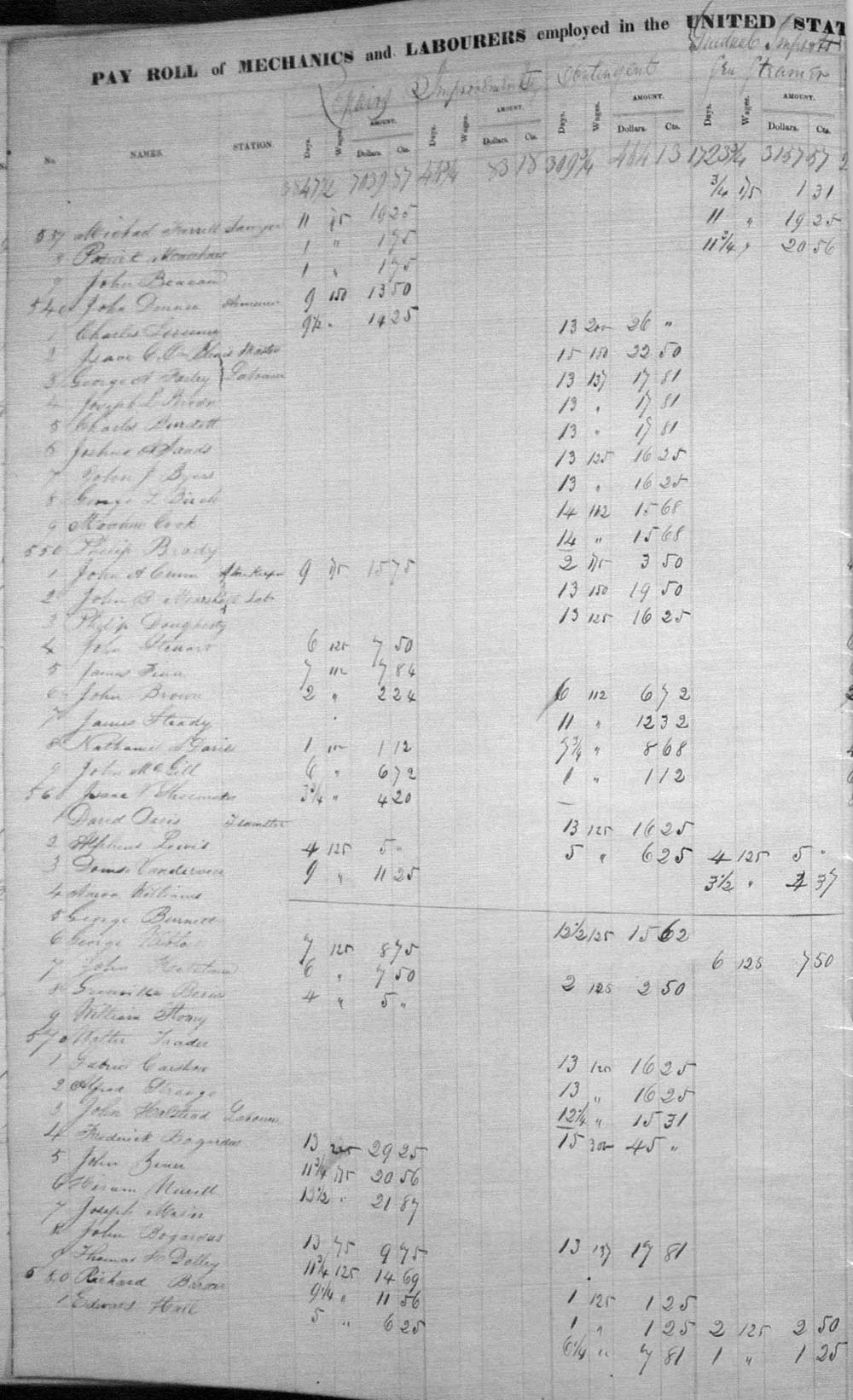
BNY payroll for 1 to 15 October 1840
Introduction: This is a small sample of the BNY payroll for 1 - 15 October 1840. The biweekly payroll for these two weeks consisted of 780 employees. The total for the entire BNY workforce was $ 15,089.31. Employees were paid per diem that is only for days worked. The number of work days varied, depending on employee occupation, number of ships under construction or repair, weather and naval appropriation. Employees were paid every two weeks, during the nineteenth century, employees were accorded no paid sick days, or vacation. At BNY in 1840 the only paid holidays were Christmas and July 4th.
Where I was unable to determine a name, I have so noted in brackets. Where possible, I have arranged all transcribed material in a similar manner to that found in the pay roll.
Source: National Archives and Records Administration New York, Record Group 45, 181.3.5 Records of the New York (Brooklyn) Navy Yard (New York, NY) payrolls 1840.
Payroll of Mechanics and Laborers Employed in the United States Navy Yard, New York from 1st to the 15th of October 1840, inclusive: IMAGE
Proscription at the Navy Yard, BrooklynSource: Albany Argus Albany New York, 2 July 1841, p. 2.
The foremen, who are democrats, were discharged on Saturday, from the employment of the Government. Their names are Mr. S. Hart, carpenter; Mr. Boyle, plumber, Mr. Boyse, joiner; Mr. Crowel, painter, Mr. Fordham, inspector of timber; Mr. Turner, gun carriage maker; Mr. John Carrigan, sawyer; and Mr. John Halstead, laborer. The foremen who are federalists, some of whom have been employed for twenty or thirty years are retained. The people may now understand the hollowness of federal profession, and falsity of the charges made against the democratic administrations that have preceded the present. Federalists have been employed at the Brooklyn Navy Yard for twenty consecutive years and their opinions have never been asked. Four months of the present administration have hardly expired and almost every democratic foreman is discharged.
Naval Reception of the Prince De Joinville
Source: Commercial Advertiser New York, 27 September 1841, p. 2.
The reception of the Prince De Joinville by the officers of our navy, has been marked with all the courtesy due to so distinguished a visitor. On the arrival of La Belle Poule a salute was fired – which was promptly returned by the United States ship North Carolina. The Prince soon after visited the North Carolina, and the visit was next day returned by Commodore Perry, who directed the civilities of the port and conveniences of the dock yard to be tendered for the use of the Prince’s ships.
On Saturday agreeable to invitation, the Prince visited the Navy Yard and Brooklyn where a salute of 21 guns was fired on his arrival. A full garrison of marines and a volunteer company, who had handsomely offered their services, were drawn up in the yard to receive him, flag flying on the ships of war. After visiting the Commandant’s quarters and receiving the hospitalities of the Navy, the Prince visited the workshops, rope-walks &c. with all of which he expressed himself highly pleased and with the general arrangements of the yard. On leaving the yard, a salute due to the naval rank of the Prince was fired, which was duly acknowledged on his arrival on board La Belle Poule.The Navy Yard "the State’s Prison…"
Source: The Brooklyn Daily Eagle Brooklyn, New York, 1 April 1842, p. 2.
The Navy Yard at Brooklyn, under the present commandant, should certainly be called the State’s Prison, for the only difference exisiting under his artbitary, aristocratic and overbearing regulations in regard to the reseptable mechanics who work under him is, that he does not lock them up at night – which he would doubtless be pleased to do. Since he has been in command, he has issued orders entirely different from all other officers that ever commanded the Yard. Firstly he is not allowing anyone respecatable who may visit it, to pass through either of the ship-houses. And secondly, in not allowing one mechanic to speak a word to his brother mechanic. A vistor is neither allowed to pass a word to any of the workmen; nor to enter any of the work-shops, for if one of the workmen is seen speaking to or is known to have introduced a stranger in the shops, he is discharged. He does not allow any of the mechanics to work on stormy days, when at the same time, there are hundreds in the Yard who work under cover the year around. Another regulation is, that if a mechanic, either by sickness, or any other unavoidable circumstances, looses three days of work, his name is strickened from the roll, nor can he get back without going in person to his would be Lordship with a certificate from a doctor; and sometimes it has been known to take four days before the mechanic who was so unfortunate as be sick, could have an audience with the gentleman. Such are few of the new regulations introduced. S
The Steamer Missouri –
Source: The Brooklyn Daily Eagle Brooklyn, New York, 4 May 1842, p. 2.
The experimental trip of the Steam Frigate Missouri yesterday, about the waters of our noble bay seems to have been highly satisfactory in all respects, as we learn from the New York papers. Her average speed was about twelve knots, and her consumption of fuel one ton per hour. So it is settled that our machinists can build a steam vessel second to none. While on the subject, we would state for the benefit of our Commodore, and others in authority with him, that the Navy Yard is located at Brooklyn - that there are three newspapers published daily in that little town – and that common courtesy would seem to require that matters of interest occurring at the yard should be communicated to one or the other or if it might be not too much of a stretch a great kindness to all three of them. We have received numerous complaints in regards to the manner of doing things at this station but have hitherto refrained from publishing them. There is no telling what justice may yet require at our hands.
A Navy Yard Critic
Source: The Brooklyn Daily Eagle, Brooklyn, New York, 6 May 1842, p. 2.
Mr. EDITOR – My attention has been invited to an article in your paper of the 1st ult. over the signature of "S" purporting to set forth the regulations of the Navy Yard at this place, under the present commandant. Had "S" given a fair and correct statement of the case, the public should not have been troubled with one word from me.
Before, however I proceed to state the facts as they are, I unhesitatingly pronounce the article a base calumny and the writer reminds me very much of a little dog barking at the moon, his howling cannot reach his object of malignity, he is protected by the broad shield of even-handed justice and an ardent desire to promote the public good, which are too conspicuous to escape the notice of the most careless observer and too prominent to meet the approbation of very honorable mind.
"S" calls the Yard a State’s Prison. If so, it’s the inmates who suffer a voluntary imprisonment, for no man is compelled to submit to its regulations. If there are any orders different from what has been usual, it is because of the shameful abuse of the public interest require them. The United States has an immense amount at stake in the Navy Yard, and one spark of fire might, in a moment destroy the whole. Persons having been discovered smoking segars in the ship houses, and this is the reason why an order was issued preventing all persons not attached to the yard from passing through those houses. There has been, Mr. Editor, so much waste of time and idleness practiced in the Yard, that it is high time, nay absolutely necessary, to correct abuses. This, I am well assured from strict observation, has been the chief aim of Commodore Perry, and the idle nonsense of "S" that one mechanic cannot speak to another &c is too absurd to need reply. There was a standing order before Commodore Perry had command of the yard against persons visiting the different workshops, except on business; and it is evident that were persons permitted a pleasure to visit them with their thousand guests the men would be impeded very much in their work, besides much public property would be endangered.
"S" says mechanics are discharged for introducing visitors into shops. Why does he not come out like an honest man and say they are not suffered to pocket the public money as formerly, and idle half the time in amusement with their friends. If any man employed in the yard wishes to gratify the curiosity of friends by going through the different shops &c, he can do so, by going to the clerk of the yard and checking himself. "S" complains that mechanics are not allowed to work on stormy days. Neither should they when it is impossible that they can do a faithful days work. You are aware, Mr. Editor, no doubt that pay in the yard is much higher than outside; and it is a crime that the Commandant should refuse to allow men to commence a day’s work, when he feels assured that they cannot do public Justice?
"S" complains that if a man is sick, absent three days, his name is stricken from the roll. This was an order in force long before Commodore Perry has charge of the yard, and if I am correctly informed, was procured by a conspicuous officer of the yard, in part for the following reasons. A number of idlers would manage to get their names enrolled on the books, work a short time, drink, gamble and frolick a long time so that they were an injury to the publick by retarding the work and preventing industrious men from getting employment.
Let any individual that has been in the habit of visiting the yard for a few years back, now come and observe the difference and he will find that ships are springing up almost as if by magic and that every department seems to be vying with each other as to which can excel in performing their duty most faithfully, and by exerting themselves to promote the public interest and this brought about under the correct management and business habits of the present Commandant. Pardon me sir for spinning out this communication so long; but I could not have said less and done anything like justice to a high minded honorable gentleman and meritorious officer.Brooklyn, April 5, 1842
A STRICT OBSERVERThe Launch of the Savannah
Source: The Brooklyn Daily Eagle, Brooklyn, New York, 25 May 1842, p. 2.
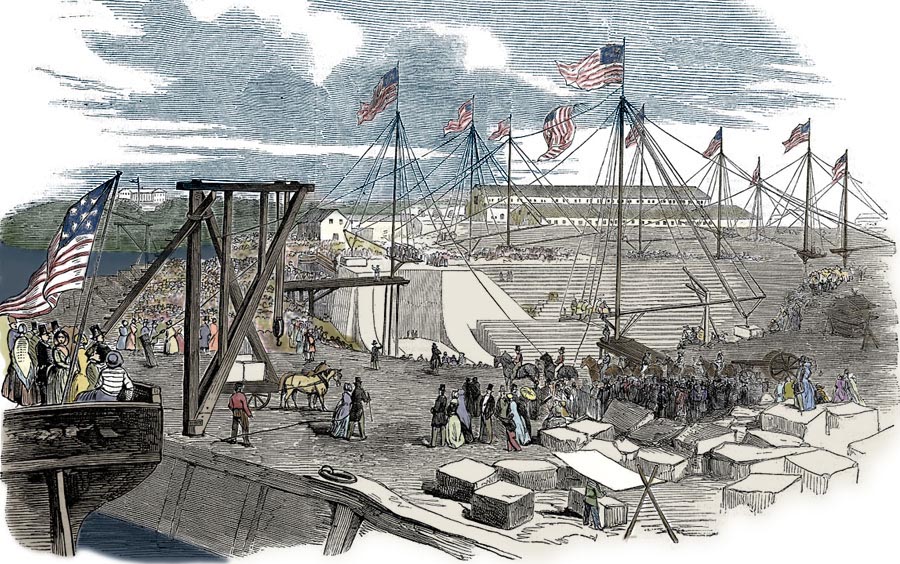
Probably not less than fifteen thousand persons were present this morning to witness the launch of the frigate Savannah. Long before the appointed time crowds were thronging toward the Yard, and every available inch of space from which the spectacle could be observed was soon taken up. The roofs of the neighboring buildings were alive with spectators; but owing to the admirable arrangements of the Commodore (not the least meritorious of which was the erection of seats for the ladies) no accident occurred, if we except an unexpected shower bath received by a detachment of some two thousand persons, collected on the docks enclosing the rails, adown which the gallant ship glided smoothly, and rode her destined element like a majestic goose. The sudden rise and dash of the water caused many wet feet, spoiled some fancy slippers, sprinkled a lot of flaunting silks and satins and frightened all hands prodigiously.
The foolish ceremony of breaking a bottle or two of wine on the occasion was performed. It was an interesting affair throughput – always excepting the wet feet, &c., aforesaid.P.S. One Lady fainted.
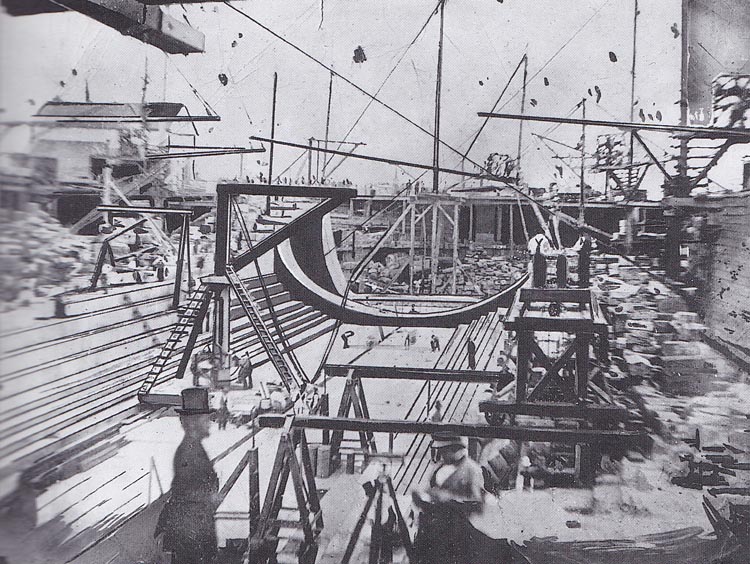
Source: The Brooklyn Daily Eagle, Brooklyn, New York, 22 April 1846, p. 2.
Note: BNY Dry Dock No. 1 was built between 1841 and 1851, and modeled on Norfolk Naval Shipyard Dry Dock completed in 1834. For Brooklyn Dry Dock No. 1 was a source of civic pride, which the Brooklyn Daily Eagle compared to the Egyptian pyramids.58 At various times the dock employed upwards of seven hundred men, excavating and removing earth and shaping the new dock. The work while dangerous provided employment for thousands of new immigrants.
58. Brooklyn Daily Eagle, Brooklyn, New York 3 August 1846, p. 2.
The Dry Dock a Dreadful Accident
While the men were at work on the United States Dry Dock, Navy Yard yesterday afternoon about 2 o’clock, one of the booms accidentally fell on Peter Hanaberg, a foreman, whose head was crushed; and also on Owen O’Brian (laborer) whose shoulder blade was broken; James McMahon, (laborer) was also injured. Mr. Hanaberg has been employed at the Long Island Railroad, and as Ferry master at the Catherine Ferry. The wounded men were taken on board the North Carolina, and put under the charge of the surgeon Baribino, where Mr. Hanaberg died in about half an hour after the injury. An inquest was held at 11 o’clock this afternoon, at the house of the deceased, corner of Willoughby and Bridge Streets, and a verdict rendered accordingly.
Launch of the Sloop of War Albany
The Launch of the Sloop of War Albany at the Brooklyn Navy Yard on Saturday morning, drew together immense crowds of spectators. The docks and numerous vessels, streets and windows were all filled. In the yard, and in the most eligible location, several platforms were erected, upon which sat the Court of Errors and Common Council of the city of Albany and the Common Councils of New York and Brooklyn. . . The pupils of the Deaf and Dumb Institution were also present, and a great number of ladies. The launch was very beautiful - Capt. Hudson and a party of ladies and gentlemen being on board, the band playing Hail Columbia.
She is a sloop of war of 1,000 tons, and mounts 16 thirty-two pounders and 4 Paxihan guns, 64 pounders. She will carry all told, 200 men, and six months provisions and 100 days water, carried in forty-four iron tanks, holding 22,000 gallons. She will be rigged and ready for sea in 60 days. Her entire cost will be $ 129,000. She is named after the city of Albany, and in return for this, a number of the wealthy residents of that city have obtained a very fine painting of the city which is to adorn the cabin.An Hour at the Brooklyn Navy Yard
Source: Brooklyn Daily Eagle Brooklyn, New York, 22 January 1847, p.2.
We were highly gratified this morning with a visit to our Navy Yard Dry Dock, and the rapid progress which has been made on the removal of the excavation from the pit. There are about six hundred men employed in all of the various branches of the work, chiefly digging out the pit. We took a stroll over the subterranean regions of the work and were agreeably surprised to find the means which have been taken to lead off the water by drains, running to pumps, have rendered the whole excavation at the depth of more than 30 feet below tide water, as dry as many of our sand hills. Several novel modes of removing the excavation are in successful and some in them as far as we could judge very economical operation. In one place the earth is loaded into large cars which are hauled up to the level of the surrounding ground on incline railroad planes by surplus power of the engine pumps. The cars are thence moved by horses on temporary rail roads to the pond in the yard, where the earth is used for filling up what had long been an unsightly feature of this yard. In other places we observe them hoisting out earth in tubs suspended from a long boom crane, the surplus power of the engine pumps being also used for that purpose. Nearly one hundred men were also employed in wheeling out the earth in an old fashion manner, the expense of which contrasts unfavorably with the other plans in use. The excavations have been earlier to the full depth required of the pit adjoining the bay within two feet of the depth (40 feet) at the land side of the pit. Preparations were making for the commencement of driving the foundation piles. This work will commence next week. At the wharves were two vessels being discharged loaded with granite, one of which contained some of the cut stone brought from the State of Maine.
The Dry Dock
Source: Brooklyn Daily Eagle Brooklyn New York, 26 January 1847, p. 2.
The Dry Dock at the Navy Yard is progressing as rapidly and successfully as its most sanguine friends could wish. There are now employed upon the work about seven or eight hundred men, who cause it to go bravely on. This morning they were to commence driving piles for the foundation, about one tenth of the pit having been already sufficiently excavated for that purpose. The accident on Sunday which gave rise to so much exaggerated rumor, proves to have been a mere bagatelle. There are now no fears of another breach in consequence of the engineer having so well secured the pit from any danger of the recurrence of those accidents.
Source: Charleston Courier, Charleston, South Carolina, 22 April 1847, p. 2.
The New York Journal of Commerce says – The Dry Dock at the Brooklyn Navy Yard is making rapid progress. The new steam pile driver recently set up there, has been tested and is competent to make sixty blows in a minute. About 400 men are now employed at the Dock,. The Sabine, a frigate of the largest class, is ready for launching, and it is expected will soon be afloat.
Rapid Progress
Source: True Sun, New York, New York, 5 June 1847, p. 1.
The mason work of the Naval dry dock at Brooklyn is in rapid progress. The Nasmyth steam pile driver is at work. It drove on Wednesday one pile 40 feet long, in one minute. On Thursday its average work was seven miles per hour.
Station Log Entries for 5, 6 and 15 July 1847
Source: NARA Record Group 45, entry 456, volume 7, New York (Brooklyn) Navy Yard Station Log.
Note: These three transcribed station log entries for 5, 6 and 15 July 1847 provide some idea of how national holidays such as July 4th were observed, the scale of navy yard operations, size of the workforce, and building of the Dry Dock Number 1.
Remarks of the U.S. Navy Yard, New York
Isaac Mc Keever, Esqr. Commandant
William L. Hudson, Esqr Commander
Monday, July 5th 1847.The last 24 hours commenced with Calm and Clear pleasant weather, at 8 A.M. light breezes from the South West and Clear pleasant weather, at Meridian light breezes from the West with Clear pleasant weather, at 4 P.M. light breezes from the South with Clear pleasant weather, at 8 P.M. Wind the same with passing clouds, at Midnight Calm and Clear pleasant weather to the end.
This being the day to Celebrate the Seventy-first anniversary of American Independence, no work was done in the Yard. At 1 P.M. a national salute of 21 Guns was fired from the Saluting Battery and the same repeated by the receiving ship North Carolina in honor of the day.
Remarks of the U.S. Navy Yard, New York
Isaac Mc Keever, Esqr. Commandant
William L. Hudson Esqr. Commander
Tuesday, July 6th 1847.The last 24 hours commenced with calm and variable weather, at 8 A.M. light breezes from the North and clear pleasant weather, at Meridian light breezes from the North East with passing clouds, at 4 P.M. wind the same and cloudy weather at 8 P.M. Calm and clear pleasant weather to the end.
Arrived at 1 P.M. the Sloop Merrimack, Stillwell Master, and sailed from the Yard at 3 P.M. with 7 Anchors of the following weight viz. 180 lbs., 290 lbs., 360 lbs., 480 lbs., 509 lbs., 676 lbs., & 700lbs., loaned by the Commandant to Major Delafield of the U.S. Engineer Corps.
A gang of Carpenters employed repairing the wharf, and another gang employed repairing the Dredging Machine with Caulkers also the Yard Camels. The other mechanics variously employed in the Yard and workshops, the laborers employed cleaning Tanks & in various objects.
"Taken on" 1 Plumber, 1 Sawyer, 1 Carpenter, 1 Yard laborer, and suspended 2 Yard labors.
Total of mechanics, laborers and others employed in the Yard. . . . 466.
Total Number of men employed in the Dry Dock . . . . . 385.
Surgeon Thomas L. Smith reported for duty in the Yard.Midnight, July 6th, R. H. Nichols
Masters Mate.The last 24 hours commenced with Calm and Clear pleasant weather, at 8 A.M. light breezes from the South with Clear pleasant weather, at meridian wind the same with passing clouds, at Midnight wind the same with Clear pleasant weather to the end.
Sailed from the Yard at 10:30 A.M. the Schooner Floriel, Joseph H. Hart master.
Arrived at 11 A.M. The Schooner Ann Ray, Moody Master with Sand for the Dry Dock.
Arrived at 1 P.M. The Sloop James Lawrence, H. Babe Master, with Cement for the Dry Dock.The Carpenters employed repairing the wharf, the other mechanics employed on various objects in the Yard and Workshops. Taken on" 1 Joiners workmen, 1 Dock builders laborer.
Total of mechanics, laborers and others employed in the Yard. . . . 449.
Total number of men employed in the Dry Dock . . . . . 447.At meridian a sale at Public Auction took place in the Yard of Condemned Muskets, Scrap Iron, and Pine wood &c &c.
Midnight, July 15th, R.H. Nichols
Masters Mate.Accident and Death at the Dry Dock
Source: Brooklyn Daily Eagle Brooklyn, New York, 1 September 1847, p. 2.
Yesterday, at the U.S. Dock now constructing at our navy yard occurred a sad accident resulting in the death of a worthy man, the workman there. By some mismanagement of the pile-driving apparatus, the iron weight attached to it, in being drawn up tilted suddenly over and leaned upon a man standing by, pressing him against a hard substance, and crushing his breast and inwardly between that and his back. Medical assistance was immediately called and at first resolved to send him over to the New York hospital; but that plan was abandoned and he was taken on a litter toward Brooklyn hospital in Jackson Street. He died on the way.
Irregularity in the Payment of the Men at our U.S. Dry Dock
Source: Brooklyn Daily Eagle, Brooklyn, New York, 8 September 1847, p. 2.
We have received the following for publication: The mechanics and laborers employed on the dry dock, having patiently waited for their pay for three days after the day set apart by the department, on their names being called at 1 o’clock yesterday (Tuesday) afternoon, declined answering. A meeting was held on the spot, and a committee of two from each department was appointed to wait upon Mr. McAlpin, engineer to ascertain the cause of the delay in the payment of the men employed. Mr. McAlpin said he was sorry the men did not answer to their names and especially Mr. Smith’s gang as they were his especial favorites. He thought the mechanics might wait a week, but the laborers could not. He said the committee had taken the wrong course and he should have to make a public example of some of the men concerned. The reason he said the men were not paid at the regular time was the clerk was delayed one day by overwork and another day by family affairs of his own. That, he said, was all the redress he could give them.
Navy Yard Workingmen
Source: Brooklyn Daily Eagle, Brooklyn, New York, 9 September 1847, p. 2.
Pursuant to adjournment, the mechanics and workingmen employed in the dry dock department of the navy yard, met at the Brooklyn hotel for the purpose of adopting measures as shall secure regularity in paying of the hands employed. The minutes of the last meeting and remarks of the several Brooklyn papers were read and on motion a vote of thanks was passed to the Brooklyn Daily Advertiser for its aid in the cause of the workingmen. The committee on resolutions reported the following, which were unanimously adopted:
Whereas the intervals of payment of the men employed on the U.S. Dry Dock at this station have long ceased to be regular, a reform in this particular is essential to our interest, as it is just in itself.
Therefore, be it resolved, that the neglect on the part of some departments connected with the U.S. Dry Dock in the observance of regular intervals in paying of the men employed therefore upon, has long been and continues to be productive to us of serious inconvenience, and therefore meets with our earnest disapprobation.
And be it further Resolved, that the Hon. Secretary of the navy be respectfully requested to take the subject of this one complaint into his consideration, assign a uniform period for the paying of the men employed on the aforesaid dock and enforce its observance.
On motion, a committee of one was appointed to proceed to Washington and make their grievances known to the president and secretary of the navy and seek redress.Accident at the Dry Dock
Source: Brooklyn Daily Eagle, Brooklyn, New York, 24 September 1847, p. 2.
An Unfortunate casualty at the U.S. Dry Dock this morning which resulted in the death of Miles Kiernan a laborer on the dock. One of the large piles which are being driven into the foundation was about being hoisted to the perpendicular position in the pile driving machine by the chain used for that purpose, and when nearly up the rope secured to the lower end of the pile to steady it, and prevent accidents, slipped from the person who had it in charge. The result was a sudden swinging of the stick by which the deceased was struck in the back, causing instant death. A coroner’s jury was held, how rendered a verdict of accidental death in accordance with the facts of the case.
Source: Brooklyn Daily Eagle, Brooklyn, New York, 23 July 1849, p. 3.
Accident at the Navy Yard - A serious accident occurred at the Dry Dock in Navy Yard on Friday afternoon last, occasioned by the breaking of one of the small derricks used to hoist stone at that place. It was owning to a defect in the cast iron just above mast head, which upon being examined after the accident, had the appearance of honey comb. Three men named Thomas McGovern, Henry Burns and John Farrell were all more or less seriously injured. McGovern had his collar broken, Burns one of his arms, and Farrell received several bruises. They were immediately removed to comfortable quarters and every attention paid to their case. We are informed that no reliance can be placed upon cast iron for such purposes, for although it may look perfectly good and sound outside, it is very likely to be spurious and good for nothing.
The Navy Yard and Political Favoritism
Source: The Brooklyn Daily Eagle Brooklyn New York 11 October 1849, p. 3.
This bit of satirical humor appeared in the Brooklyn Daily Eagle on 11 October 1849. The writer aimed his barbs at the Whig Party winners of the election of 1848 and its leader Zachery Taylor... The anonymous Democratic author makes fun of the Whig party, compares their platform to a religion and jibes at their leaders installed at the navy yard and their control of the hiring process. The "Locofocos’ (also Loco Focos, Loco-focos) were a faction of the Democratic Party that existed from 1835 until the mid-1840s. . .
Political Levee and Political Catechism
The Hon. Mr. Bokee, M. C. held his first levee for the benefit of his anxious friends on Saturday last at his residence in Hicks Street. It was a rainy day, but notwithstanding the storm, the street was thronged with from fifty to one hundred hopeful converts to the faith and doctrines, as taught and expounded by our "worthy representative of some of his constituents."
Previous to receiving a passport to the land of promise, (the Navy Yard) each applicant was excised in the catechism of his political faith. The form of the catechism was sanctioned by Old Zach, and the questions propounded by his honor.Q. - What is your name?
A. – Michael A. Weathercock, your Honor.
Q. - What is the chief duty of a member of the congress?
A. - To get men into the navy yard.
Q. – Was you born in a state of sin?
A. – No, I was born in auld Ireland.
Q. – Did you ever fall from grace?
A. – Yes, two years ago at the spring election.
Q. - What are the wages of sin
A. – Whig promises.
Q. – Who are the three greatest men living?
A. – Old Zack, Misther Stryker, Pat O’Donnell and your honor.
Q. –Before receiving your passport to the navy yard, will you take the " Bokee Pledge"?
A. – Yes, your Honor, I’ll do that if I’ll will get me in the navy yard.Repeat the" Bokee Pledge"
"I solemnly promise and agree to renounce locofocoism and will vote the Whig ticket at the next election"
"That will do! Here is your ticket! Report yourself to Boss Rhodes, don’t work too hard, and if you find any locofocos in the yard report their names to me forthwith for my contentious convictions will now permit Whigs who will take the Bokee pledge to work in the navy yard so long as I wear the honors of a member of congress.’Political favoritism Irish vs Native and Whig vs Democrats.
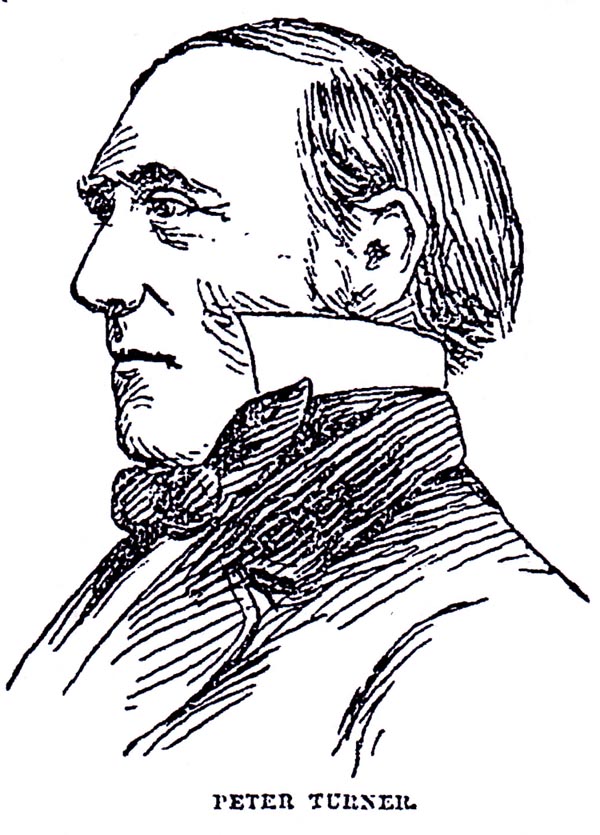
Note: The following letter to the Brooklyn Daily Eagle decries the perceived favoritism shown toward native born Whig Party supporters after the election of 1848. Following the election many supporters of the Democratic Party at the navy yard were replaced with supporters of the Whig Party. This letter writer "Felix" focuses on the discharge of Peter Turner gun carriage maker born 1787 in Ireland who died in Brooklyn New York Dec 31, 1863. Turner worked at BNY for many years as gun carriage maker. Turner, was known for his devotion to the Catholic Church, and his work to help Irish immigrants and improve the lot of working people. The letter writer makes the point that Turner was fired for being an Irish and a Democrat. His obituary stated he was helpful in finding employment for those recently arrived from Ireland. He led the Irish fraternal society "The Erin Fraternal Association' and Roman Catholic Orphan Asylum. His wages as Foreman in May 1848 for 14 day period @3.00 per day week $ 42.00. His son John M. Turner, became a priest and was Vicar General of the New York Diocese.59 Turner is enumerated in the circa 1849 Whig Party list of possible replacements at BNY http://genealogytrails.com/ny/kings/navyyard.html "of the worst sort" likely a reference to Turner’s Irish heritage and championing of Roman Catholic causes.
59. Brooklyn Daily Eagle, Brooklyn, New York, Dec 23 1894, p. 8.
*
Mr. Editor – I will now canvass the relative merits of this Whig foreman and of their democratic predecessors. First then is William H. Hallock, the present foremen of the shipwright’s department. This man received his appointment with no other qualifications than that he was a "Bokee Whig." He knows nothing of the science of ship building, such as drafting, laying out plans etc. He possesses a very limited education and is incompetent to be foreman of his department, as a tailor to make a watch. Mr. Weeks his predecessor, was a scholar, and possessed mechanical abilities of the highest order, as is proved by a model steamship made by him now in the Lyceum which took the premium at the fair in the year 1847.
I will now ask if it was a redeeming of "Taylor pledges" to discharge such a man as Mr. Weeks, to make room for such a man as Mr. Hallock?
Next the gun carriage department, Mr. Turner has been in this department for a number of years, and was considered by officers in the navy as the best gun carriage maker by the officers in the navy. Having never received more than journeyman’s wages it was some time before they could find a pretense for discharging him. Finally Bokee decided he should be discharged as no Irishman should hold an appointment when an American wanted it. . .
Mr. Turner was discharged and his place filled by a Mr. Wrighington, a man who never made a gun carriage in his life! His principal claim to the situation was on account of his having been a strong Native. I will now ask the adopted citizens if they are prepared to support a party that has prescribed one of their own numbers for no other reason than his being an Irishman? FelixSource: Brooklyn Daily Eagle, Brooklyn, New York, 27 October 1849, p. 2.
John MegillSerious Accident at Navy Yard
Source: Commercial Advertiser New York, New York, 16 April 1850, p. 2.
As Mr. John Megill, attached to the Storekeepers department was engaged in packing clothing on Saturday afternoon between 5 and 6 o’clock, he came across a 6 ounce vial which was lying about for some time and to get it out of the way, threw it in the stove, causing instant explosion, blowing the stove through the floor, seriously wounding himself and causing a general alarm throughout the yard. The vial is supposed to have contained fulminating powder. The right hand and arm of Mr. Megill was so badly injured that immediate amputation was found necessary and the operation performed taking the arm off at the elbow.60
60. John Warden Megill 1814 -1867 for biography see Hix Charlotte Megill
http://www.findagrave.com/cgi-bin/fg.cgi?page=gr&GSln=Megill&GSfn=john+&GSmn=warden+&GSbyrel=all&GSdyrel=all&GSob=n&GRid=125442376&df=all&
Accessed 2 December 2016.Launch of the USS San Jacinto
Source: Brooklyn Daily Eagle, Brooklyn, New York, April 16, 1850, p. 2.
This noble looking frigate – propeller, the dimensions of which we detailed last week, was launched forth into its destined element this forenoon, precisely at half past eleven.
The day being most delightful, an immense concourse of citizens with their ladies and little ones thronged the arena of the navy yard to witness the auspicious, even indeed, every accessible spot was crowded with spectators anxious to obtain a sight of the launch.
The arrangements connected with the occasion were of the most complete nature and the ceremonies of the affair passed off with the most brilliant éclat.
The unfixing of the vessel was completed in less than seven minutes, and the screw having been applied to the bows, away the San Jacinto went majestically and amidst the enthusiastic cheers of full four thousand people into the mighty deep – Having sailed about half a mile in the river, she was eventually towed back by a steamer which was in readiness.
The lady who officiated as the christener on the occasion and who was heroically seated in the bows of the vessel was Miss Cannen, a niece of the Hon. Mr. Rose, M. C., who was also present, and who with Capt. Bell of the Navy Yard presided over the ceremonies. As the ship entered the water, Miss Cannen stood up and completed the ceremony by precipitating the flowing of wine on the bows of the vessel.
During the launch the Navy Yard Band, which was stationed on a war sloop lying alongside the quay, played "Hail Columbia" in noble style and the old "Carolina" fired a national salute. At this moment the scene was most imposing as the cheers of multitude, the firing of the cannon, the national standard flying in all directions and the splendid sunshine imparted a "pride, pomp and circumstance to the occasion" which will never be eradicated from our memory. Great praise is due to Mr. Constructor Hart, under whose immediate superintendence the whole details of the launch were regulated and successfully achieved. So far we saw or learned of no accident occurred.The Brooklyn Navy Yard
Source: Brooklyn Daily Eagle, Brooklyn, New York, April 18, 1850, p. 3.
Although work is generally dull in the mechanical departments of the Navy Yard, there are some improvements going on at the present time. At the east end of the yard, between the new saw mill building and the sewer workmen are completing the foundation of a house in which oakum is to be picked by steam. The building is to be two stories high, and will be composed entirely of iron. Three spinning jennies are now being made in Massachusetts for the shop. It is expected that all the oakum required for the navy will be picked and manufactured here. On a line with this new building and the saw mill, the foundation has been laid for a gun carriage shop, which is also to be made of iron. These new buildings will probably be finished during the ensuing summer. The new steam mill is daily in operation and is one of the attractions of the yard. The machinery consists of a beam engine and two boilers, made at the foundry of Mr. Tufts, East Boston. The engine is said to be the smoothest and stillest working engine in this part of the country. It makes no perceptible noise. It operates one gang of twelve saws, for sawing ship planking; one futtock saw for sawing crooked and bedeviled timber frames and is said to be the only one of the kind in the use in the navy, one wood boring machine, one morticing machine for boring and turning holes in the lignuvitae for gun carriage &c. The mill is now sawing for the United States Steamer Mississippi which is undergoing thorough repair.
The Navy Yard
Source: The Brooklyn Daily Eagle, Brooklyn, New York, 18 October 1850, p. 2.
Upwards of eight hundred men are now constantly employed by the Government at the Navy Yard. One half of this number are engaged in completing the dry dock and the massive granite building connected with it, which is to contain the steam engine, pumps &c. The work is advancing rapidly.
BNY and the Election
Source: The Brooklyn Daily Eagle, Brooklyn, New York, 1 November 1852, p.,2.
Note: As described in the following article the practice of hiring large numbers of laborers just prior to an election who in return for employment would vote for the party in power was a common practice.
Mr. Editor – Within a few weeks past nearly one thousand laborers have been imported to the Navy Yard, although there is no work going on in the Yard to justify such an increase. The number at present employed is nearly twice as large as ever having been before, even in these stirring time. I have become acquainted with some political movements which have recently taken place in the Yard and deem it a duty to expose them. The Whig officers and their assistants came to the conclusion that if they could only fill the Yard to over flowing for a few weeks they could carry their local ticket. In order to do this they must have the cooperation of Commodore Salter, and knowing the soft spot in his character, they purchased a silver pitcher that weighed forty ounces and cost they state $150.00. The pitcher was tendered to the Commodore, but he wrote a letter to the parties presenting it declining to accept it, but stated that they might take it to New Jersey and present it to his lady, which they did. They then succeeded in bringing into the Yard as many men as they wanted from all parts of the city. They have selected a candidate for Alderman of the Fifth ward, and already have threats been held out to workmen in the Yard that they will be discharged if they dare vote for any other man. Will the independent laborers and workmen in the Yard allow themselves to be used by political intriguers to elevate men to office whom their souls abhor? Will they sacrifice their independence as free citizens for a few days’ work, and become passive tools in the hand so of designing, unprincipled politicians? There are now 1,400 men employed in the yard, but immediately after the election everyone taken on for temporary purposes will be discharged. Fellow workmen do not disgrace the franchise, do not act in a manner that your conscience will rebuke you for, but go to the polls and vote according to your own your convictions. Do not fear the Whigs for their time in authority will now be very short, and if any of you are discharged for voting like freeman, according to your own convictions, your loss in the end will be your gain. FELIX
Strike for the Ten Hour Day: On 14 December 1852, Secretary of the Navy John P. Kennedy arbitrarily attempted to set aside President Van Buren's 1840 ten hour workday order, hoping to increase production at all naval shipyards. Kennedy’s order stated the workday at naval yards was henceforth to begin an hour earlier or from sunrise to sunset. His order effectively extended the workday to eleven hours. At Brooklyn, Philadelphia and Washington DC, his order resulted in a strike of nearly all mechanics and laborers. These strikes and adverse publicity made the new Fillmore administration quickly reconsider the wisdom of the extension and Kennedy rescinded his order just forty-eight hours after it was issued and BNY returned to work.
Strike in the Navy Yard
Source: The Brooklyn Daily Eagle, Brooklyn, New York, 16 December 1852, p. 3.
For the last two days the laborers employed in the Navy Yard have been off work owing to an order issued on Tuesday requiring the men to add an hour to their time of labor, as at present arranged by the regulations of the Yard. The order was received from Washington by Commodore Boardman, Commandant of the Navy Yard. It was posted at the muster house as soon as received so that all employed in the Yard could learn its import when coming out to dinner.
On the same evening the laborers held a meeting at the Brooklyn Hotel in York Street and appointed a Committee, who were instructed to consult with the Commandant of the Yard upon the subject, and the conclusion was arrived at that they would resume work the following morning (yesterday) at the hour designated in the order. The laborers, however to the number of about 1000, assembled in front of the gate in the morning, and the majority appeared in favor of holding out, and those dispersed to work were induced to side with the larger party in the hope that the order would be countermanded. So things stand at present. Some three months since a similar attempt was made by the department but the order was resided in a few days afterward. The workmen appear to be of the opinion that by refusing to comply with the requirement a similar result will follow.
Source: New York Times, New York, 17 December 1852, p. 6.
Workers at the Navy Yard declared they will not return to work unless they are allowed to work the eight hour day as formerly. Everything was quiet yesterday and the men were anticipating a favorable reply to the telegraphic dispatch sent to Washington on the first day of the strike.
Source: The Brooklyn Daily Eagle, Brooklyn, New York, 17 December 1852, p. 3.
It seems that the order recently received at the Brooklyn Navy Yard, which caused the strike among the workmen, is not the only order that has been issued.
There is great excitement at the Charleston Navy Yard, in consequence from the order received from Washington requiring the men to commence work ten minutes before sunrise. A meeting of the workmen was held at City Hall yesterday forenoon and was largely attended. Resolutions were adopted protesting against the order of the Naval Bureau, adding one hour to the day’s labor, and determining not to work until the order was countermanded. The meeting was orderly. Eight hundred men are now employed in the yard.
In Philadelphia the same state of things exists, and the workmen refused to work.
In this city the Navy Yard employees still continue on strike, awaiting the receipt of order from Washington but up to the last evening no word was received. The report published yesterday morning that a similar order at the Philadelphia Navy Yard has been rescinded has encouraged them to hold out hopes of a similar result here. It appears that the hands in the Yard work nine hours in the summer and eight hours in the winter, and the recent order which requires them to work nine hours per day at the present time is what they are standing out against.
The Navy Yard Order
Source: The Brooklyn Daily Eagle, Brooklyn, New York, 20 December 1852, p. 3.
The order compelling the workmen in the Navy Yards to work an additional hour has been rescinded. The following counter order has been addressed to the various commandants of the Yards from the Bureau of Docks and Yard, 16th December 1852.
Commodore: The order issued from this Bureau by the authority of the Secretary of the Navy respecting work hours at the several Navy Yards is by his direction suspended till further instructed upon the subject.
Respectfully, your ob’t Servant
Joseph SmithSo there is a Smith at the bottom of the business. The Smiths seem to be mixed up with all the different questions that arise in the country.
Destructive Conflagration at Navy Yard - Loss $155,000
Source: Brooklyn Daily Eagle, Brooklyn, New York, 18 April 1853, p. 3.
A fire involving a greater loss of property than any which occurred in this City since 1848 occurred yesterday morning at the Navy Yard. The fire broke out in one of the large buildings, 300 feet long and 60 feet wide, which together with most of the contents was destroyed. The building was occupied on the ground floor as a place of storage for various kinds of lumber. At the time of the fire there were stored there beams (Southern pine) and frames (oak) for two frigates and one sloop of war, besides a large quantity of ship-knees and other materials including a quantity of timber which had been experimented upon for years. The loss in this department is estimated $60,000, very little being saved and that only in a damaged state. A portion of the easterly end of the building was occupied as the gunners-room for repairing. The loss in this department is confined mostly to the tools and a small quantity of stock – loss $5,000. The second floor of the building was occupied as the painters department, in it were a large quantity of paints and oil a portion of which had only been placed there on Saturday, loss $20,000. The fire was first discovered about 9 o’clock when the flames were breaking through the roof about the center of the building. It originated in the paint shop from spontaneous combustion, produced, as is supposed, in a waste barrel where paint skins and linseed oil were thrown. It is stated that a fire occurred in the same shop about nine months since from the same cause but was discovered in time to prevent a conflagration. The building cost $20,000. Soon after the fire reached the gunner’s room there was two explosions, afterwards ascertained to be from old bombshells which had been thrown in carelessly as old iron. The explosions were light but insufficient to cause a suspension of work by the firemen until the facts were ascertained from the person supervising the department. The Fire Department together with the Chief of Police and Assistant Captains, with a large number of Police from each District, were promptly on the spot and rendered all possible aid, but the inflammable nature of the contents rendered their attempts nearly useless. Three engines belonging to the Yard, as also the Steam engine at the Dry Dock, were brought into requisition, but for some reason not until after a portion of the Brooklyn Fire Department had got to work. Commodore BOURMAN, together with many officers belonging to the Yard, were active in their endeavors to extinguish the flames, but when this was found to be impossible, the Government oxen were set to work at dragging out the large oak beams, by which means considerable property was saved, most of it, however, in damaged state. The whole loss will not fall short of $ 150,000.
The Navy Yard carpenters make a respectful demand
Source: New York Times, 22 April 1853, p. 4.
The Navy Yard. – The Carpenters at work in the Navy Yard last week made a respectful demand for an increase of wages - two shillings per day. Their request was transmitted to Washington and a favorable answer was returned. The workmen now receive the desired advance. During the week about one hundred laborers have been added to the force employed in the Yard, and also additional hands were set to work in several of the mechanical departments. The boiler of the dredging machine, which exploded a few weeks since, has not been raised yet.
Excursions
Source: Brooklyn Daily Eagle, Brooklyn New York, 17 November 1853, p. 3.
The cry is "still they go." The Danegar Guard (so named in honor of the Master Plumber in the Navy Yard, and composed principally of the best looking young men under his charge) they are making preparations for their first annual target excursion to take place in the 23rd instant. The company will be under the command of Captain JOHN HUNT. The number of shoots will be regulated by the number of muskets to be found in the city.
Ship Carpenters Pay
Source: Brooklyn Daily Eagle, Brooklyn, New York, 3 June 1854, p. 3.
The ship carpenters employed at the Brooklyn Navy Yard have struck for higher wages and created work on the frigate Sabine. They were receiving $2.75 per day, but demanded $3.00.
Crushed to Death
Source: Irish American, New York, New York, 12 August 1854, p. 3.
A man named Bowlen was crushed to death in the Navy Yard by the upsetting of a gun carriage near where he was sitting.
Jesse Morell Folk, Master Joiner
Source: The Brooklyn Daily Eagle, Brooklyn New York 26 November 1854. p. 3.
Note: Jesse Morell Folk, September 22, 1804 to January 4, 1894, was a leader in Democratic Party politics and a prominent figure at the navy yard. Starting as laborer, Folk quickly became overseer of the navy yard laborers and later master ship joiner. Master workmen such as Folk exercised considerable power especially so when BNY moved to hire or discharge employees and the master workman was delegated authority to make up the list.61 In the often acrimonious world of nineteenth century politics Folk was the subject of much speculation. In April 1842 he was charged with assault and battery against fellow Democrat Francis C. Treadwell. Treadwell charged Folk with pushing him off the stage when he was trying to speak. At trial witness testimony was nearly evenly split. The jury ruled for the plaintiff but many were in doubt; Treadwell was awarded just six cents in damages (see Brooklyn Daily Eagle, April 29, 1842, p. 2). In the 1850’s Folk organized fifty-five BNY mechanics yard working men into a semi military militia "the Jesse M. Folk Guard" which met for drill and target practice. These local militia or guard units were common place in New York City during the 1840’s and 1850’s. Such groups were often organized by Democratic and Whig party politicians and local ward bosses to insure electoral support and intimidate their opponents. While these groups collected a "voluntary assessment" they also provided workers access to employment, job security and a sense of dignity and cohesion.62 In 1848 Folk is enumerated on the BNY Payroll for 16 to 31 May 1848 as a supervisory laborer, wages $ 2.50 per day.63
For the 1848 Whig Party comments re Jesse M. Folk, see http://genealogytrails.com/ny/kings/navyyard.html
61. In 1859 Commodore Thomas R. Root testifying before a congressional committee about BNY replied to the question, "Was there any limit upon the powers of these masters of mechanics to put men in?" answered: "I will state this: When a change was made of one of the master workmen, the new one would come into the yard and find a gang of men already there. It became necessary to discharge some of the men for want of work, and the list was made out and approved by the master workmen, and by the commandant of the yard and the men was dismissed. When it became necessary to appoint new men, I observed that it was very seldom that many of the old ones came back again." House Documents, Vol. 119, Part II, pp 6-7,1859.
62. Adams, Peter, The Bowery Boys Street Corner Radicals and the Politics of Rebellion, 2005. p .37, and Connolly, James J., An Exclusive Unity: Urban Democracy and Machine Politics
63. National Archives and Records Administration, New York, Record Group 45, 181.3.5, Records of the New York (Brooklyn) Navy Yard (New York, NY) payrolls,1848. Jesse M. Folk, number 290.
Master Joiner Jessie M. Folk and the Jessie M. Folk Guard
The workingmen employed by Jesse Folk Master Joiner in the U.S. Navy Yard, preceded to Clifton Park, Staten Island, on the 24th instant, for target practice under the name of the "Jesse M. Folk Guard." They numbered 55 muskets and were accompanied by Shelton’s band. The following prizes were awarded:
The Navy Yard
Source: New York Times, New York, 26 January 1856, p. 8.
The Severity of the weather still renders all matters connected with the Navy Yard dull. With the exception of the few hands employed in constructing the ways of the launch of the Niagara, there are few mechanics at work and the progress of the ways is slow, the slip being entirely filled with ice.64
64. The second USS Niagara was a screw-steamer driven frigate in the United States Navy. The Niagara was launched by on 23 February 1855, sponsored by Miss Annie C. O'Donnell and commissioned on 6 April 1857, Captain William L. Hudson in command. See https://en.wikipedia.org/wiki/USS_Niagara_(1855)
Most of the mechanics employed hitherto upon the Niagara were discharged on Thursday evening, it being impossible to proceed any further in her construction until she is launched. A great part of her staging having been taken down, her beautiful model and magnificent proportions can now be seen to some advantage. Mr. STEERS may justly be proud of his handiwork.65 After her cruise in search of filibusters in the North River on Thursday afternoon, the Dispatch safely returned to her dock, having been out three hours. She is waiting orders to sail on some more adventurous cruise.
65. George Steers, August 15, 1819 to September 25, 1856, was a designer of yachts and ships best known for the famous racing yacht America. He founded a shipyard with his brother, George Steers and Co, and died in an accident just as he was landing a major contract to build boats for the Russian Czar. Between 1841 and 1850, Steers built many yachts which were well known in their day. In 1850 he formed the firm George and James R. Steers with his brother. Steers is perhaps best known as the designer of the most famous racing yacht of all time, the schooner yacht America, for which the America's Cup is named. No doubt influenced by the ship designs of fellow New Yorker John W Griffiths, the aptly named America established the American naval architecture of the day. Steers built one full-sized commercial ship, the clipper ship Sunny South. Steers last ship was the USS Niagara launched in 1856. He died in an accident on 25 September 1856 while driving a new pair of horses.
Pay of Mechanics
Source: The Brooklyn Daily Eagle, Brooklyn, New York, 15 March 1853, p. 2.
A general movement is taking place among the mechanics of the city to obtain an increased rate of salary. The carpenters have held some preliminary meetings to confer and adopt some plan of action that will enable them to carry out their views. The wages paid now to carry is twelve shillings a day. And they intended in a short time to demand $2. The smallness of their pay is not the only grievance they labor under at present; they have often great difficulty in obtaining what they earn, it being a habit of many of their employers to decline making full payments and retain sums which in time reach a considerable amount and thus curtail the earnings of the workman in a serious degree. Such deferred payments are never made unless the "bosses" are forced to it by legal process. By concerted and vigorous action the carpenters can reform the present state of things, and we can hope they will not fail to do so. An emergency meeting of the carpenters was held last evening at Mrs. Prest’s hotel to consult upon the subject. There appeared to be no concert of action. Some seemed to be satisfied with 15s, while a few, comparatively for the meeting was quite a large one, advocated and demand for $ 2. per day. The evening was consumed in discussion until a late hour when it was finally resolved to prepare memorial to be submitted to the Secretary of the Navy and the Brooklyn Common Council praying the former to increase the wages of carpenters in the navy yard from $2. to $2.25 per day, and asking the latter to allow $2. per day on all work done for the city. A committee of four for the city consisting of Messrs. Price, Vunk, Van Brunk and Grove, was appointed to prepare a memorial as provided in the resolution.
Note: Theophilus Hardenbrook, aka Hardenburgh, Hardingbrook etc., was born in New York City in 1791 the son of Nicholas Hardenbrook and Susan Walker. During the war of 1812 he joined a privateer the Zebra and became prisoner of war on 20 April 1813 when his ship was captured in the Bay of Biscay by the HMS Pyramus and HMS Belle Poule. The Zebra was an American private vessel operating as "privateer" under a Letter of Marque dated 26 June 1812. The Zebra was purposely built as a privateer by well-known shipbuilder Noah Brown at New York 1812/1813.
Source: The Brooklyn Daily Eagle, Brooklyn, New York, 26 April 1853, p. 2.General Entry Book of American prisoners of war at Dartmoor Prison, May 1814 - August 1814, ADM 103-88; # 1539 Dartmoor Prison, War of 1812, # 1539 Theophilous Hardingbrook, seaman, privateer Zebra, born New York
Following his capture Hardenbrook, a prisoner of war, was incarcerated in H M Dartmoor Prison, England. Dartmoor records him as prisoner #1539, Theo Hardingbrook as a seaman, born in New York. His physical description is age 23, 5 ft. 6 ½ inches tall, blue eyes with dark brown hair. Identifying marks a scar on his left hand. After capture Hardenbrook was first taken to Stapleton Prison and later to Dartmoor on 23 June 1814. He survived brutal prison conditions where over 200 Americans died of diseases such as smallpox, dysentery and other conditions and the notorious "Dartmoor Massacre" which wounded 60 men and killed 7 on 6 April 1815. He was released in May 1815, following ratification of Treaty of Ghent. The actual date of his repatriation to the USA is unknown, though most likely late June 1815. As mentioned in the following Brooklyn Daily Eagle article, Hardenbrook found employment at BNY with the help of President James Monroe, where he was employed for many years as master cooper. Hardenrbook was an active member of the Proprietors of Greenwood Cemetery and the Veterans of the War of 1812.
The Navy Yard Theophilus Hardenburgh [Hardenbrook] Master Cooper
Source: The Brooklyn Daily Eagle, Brooklyn, New York, 26 April 1853, p. 2.
The Navy Yard – It seems that Mr. Hardenburgh, the old Navy Yard cooper, who has been in his place some thirty years or more, came very near being ousted in the late shuffle. On going to Washington lately to look after his interests, he got an interview with Mr. Dobbin, the Secretary of the Navy, and learned that he was displaced. He was deeply pained at the news, and went on to tell the Secretary something of his history. He soon satisfied him that he had been throughout his life not only a set fast Democratic Party man, but the person ordered to be appointed in his stead was no other that originally a poor boy whom he had charitably rescued from the streets and had subsequently taught him all he knew of his trade. The Secretary appeared staggered with these disclosures, when the old man, raising his hands, exhibited the print on his each wrist of the manacles he wore while prisoner to the British during the war of 1812. The Secretary immediately revoked the order for his dismissal and the old cooper went his way rejoicing. Hardenburgh says he was originally appointed under Monroe.
Five Hundred Men Discharged from the Navy Yard
Source: New York Times, New York 16 December 1854, p.8.
Nearly five hundred men were discharged from the Navy Yard yesterday, comprising men from all the different mechanical departments and laborers. Nearly everyone employed on the United States frigate Sabine was included in the dismissal. This is particularly unfortunate at the present time when it is so difficult to obtain employment and must be the cause of much suffering. There are only some eight hundred men now left in the Yard.
Reduction of Wages at the Navy Yard. Indignation meeting of the Workmen
Source: The Brooklyn Daily Eagle, Brooklyn, New York, 8 January 1855, p. 2.
Commodore Boardman last week gave notice to the master carpenters, laborers, &c., that the wages of the men employed in the Navy Yard must be reduced – joiners from $ 2.50 to $ 2..25 per day, and the other branches in proportion. The employees in the yard, believing the commodore has no authority for this course of action, held a meeting on Saturday evening at the Brooklyn Hotel, corner of Hudson Avenue and Prospect Street. Wm. Gardiner was called to the chair and Mr. Pearsall was appointed secretary. After some consultation, the chairman was selected as a delegate to proceed to Washington and lay the matter before the Secretary of the Navy, and his interposition to prevent the consummation of what the workmen believe to be a most outrageous proceeding. Considerable indignation was expressed by the workmen and some of them thought it would be a good idea if wages were to be reduced to commence with the Congressman, Cabinet Ministers and Commodores.
Laborers Discharged
Source: New York Times, New York 12 March 1855, p. 5.
On Tuesday last between fifty and sixty laborers were discharged in consequence of the want of work upon which to employ them.
A Visit to the Brooklyn Navy Yard
Source: New York Times, New York 26 July 1855, p.2.
We visited the Brooklyn Navy Yard yesterday, Reader, we have been there before and intended to note the result in a form rather adapted for the tolerably large class of our citizens who because it was so accessible have always postponed their visit till a more convenient season than for those seeking mere temporary information. We jot down the following thanks to Mr. COLVILLE, of the North Carolina who in the absence of Lieutenant KILTY supplied us with the necessary information.
As we would assure those of our readers who have never been there, an inspection of the Navy Yard is no difficult matter to accomplish. Choose a pleasant afternoon, neither too hot nor too cold. Cross to Brooklyn by any ferry that tis convenient, the Fulon, Catherine or Gouverneur ferries being the nearest, and the fare being in all cases two cents – German kreutzers, English half pennies and French sous are invariably refused as are also all pocket-pieces, tokens and bogus coins of what kind so ever. The first person you meet unless he is a newly arrived emigrant, an Irishman that can’t speak English or German, will put you on the route, directly you leave the boat and in brief time you are there.
Do not be alarmed by the sentry at the gate, though he bears on his shoulder a musket and bayonet he is peaceably disposed and is indeed quiet and mild spoken. It may be well to avoid showing any intentional disrespect, though it is not necessary to touch your hat to him….
Let us – having first inspected this other huge ship-house in which there is no vessel on the stocks – visit the Dry Dock. It is said to be one of the largest in the country – some say in the world; but of that we know nothing. In its construction 80,000 tons of stone were used. Its foundations are 400 feet in length and 120 feet in in breath. The "main chamber" as we are informed is 286 feet long and 20 feet broad at the bottom, 307 feet long and 98 feet broad at the top. By using the floating gate, an additional length of 50 feet may be obtained.
Words fail us, similes fail us, so we advise you reader to go and judge for yourself. Go and behold no less than 1600 men uninterruptedly at work. Examine what work they do. Uncle Sam permits you to do so, and he will tell you if you ask what he pays them on the 8th and 22nd of each month. Of these men you will find about 310 are carpenters, over 100 blacksmith about 100 joiners and similar with the other occupations - There are nearly 800 mechanics at work on the new building. Take our advice and see the Navy Yard without delay.
Launch of the Niagara
Source: The Brooklyn Daily Eagle, Brooklyn, New York, 23 February 1856, p. 3.
The steam frigate Niagara was launched at eleven o’clock this forenoon. The launch was witnessed by from ten to fifteen or twenty thousand persons. The Navy Yard was filled with people, and the Williamsburgh shore and every available spot in the neighborhood from which a view of the launch could be obtained was crowded with spectators as thick as mosquitos of a Jersey swamp. Platforms had been erected in the Yard for the accommodation of the ladies and children. A steamer started in the morning from the foot of 10th street, New York side, to convey members of the Legislature, the New York City Government, gentlemen of the press, and others specifically invited by Mr. Steers to witness the launch. Everything being in readiness the wedges retaining the vessel were removed and the Niagara glided majestically into her future element, amid the cheers of the assembled multitude, the waving of hats and handkerchiefs and the booming of cannon from the North Carolina.
After the launch, which resulted in the most satisfactory manner, the vessel was towed back to the dock by two steam tugs, Leviathan and Hercules, where she now remains.
The Niagara was built by Mr. Steers, and her machinery is from the foundry of Pease & Murphy, New York. She is the largest war steamer in the world – being 6,000 tons burthen (carpenters measurement), 345 feet long overall and 55 feet beam. This is six feet longer than the great Vanderbilt which is 4,000 burthen.
The Niagara will carry 86 guns, and will require about 700 men to man her.
Seriously Injured
Source: The Brooklyn Daily Eagle, Brooklyn New York, 6 September 1856, p. 3.
A laborer employed in the Navy Yard had one of his feet smashed yesterday while engaged at his usual labor in hauling timber. He was taken to his residence in Clermont Avenue.
Affairs in the Navy Yard & Number of Men Employed
Source: The Brooklyn Daily Eagle, Brooklyn, New York, 17 November 1856, p. 2.
The new Iron Gate at the entrance of the Navy yard is now complete and making a handsome though not imposing appearance.
The whole number of men employed in the Yard, in all departments, November 1st, was 1, 560. At the present time the number on the roll is about 1,470 – some seventy five men in the engineers department and fifteen borers having been discharged a few days after the election. More discharges will probably be made today and still further reductions may be expected as soon as the weather becomes colder. The masons and carpenters will not be able to work to advantage and business generally in the yard will decrease. The sea wall to extend from the dry dock has been commenced, giving employment to a large number of stone cutters. It will cost an immense sum.
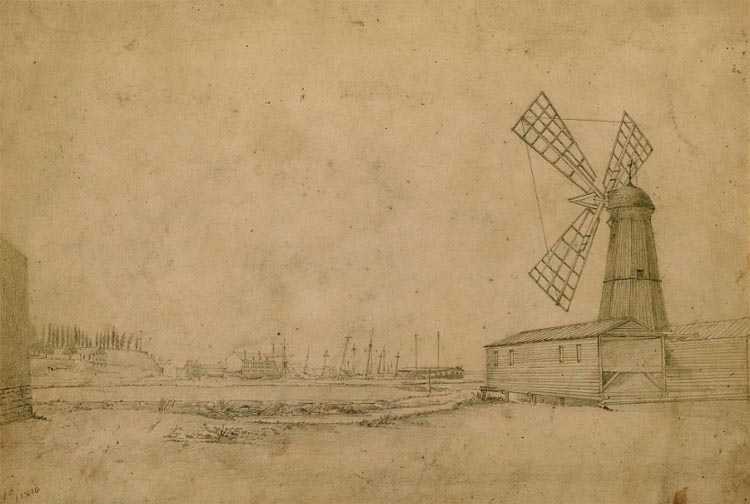
Brooklyn Navy Yard 1808
Graphite Drawing by John Rubens Smith, 1775-1849* * * * * *
John "Jack" G. M. Sharp resides in Concord, California. He worked for the United States Navy for thirty years as a civilian personnel officer. Among his many assignments were positions in Berlin, Germany, where in 1989 he was in East Berlin the day the infamous wall was opened. He later served as Human Resources Officer in South West Asia (Bahrain). He returned to the United States in 2001 and was on duty at the Naval District of Washington on 9/11. He has a lifelong interest in history and has written extensively on the Washington, Norfolk and Pensacola Navy Yards, labor history and the history of African Americans. His previous books include African Americans in Slavery and Freedom on the Washington Navy Yard 1799 -1865, Morgan Hannah Press 2011 and History of the Washington Navy Yard Civilian Workforce 1799-1962, 2004.
https://www.history.navy.mil/content/dam/nhhc/browse-by-topic/heritage/washington-navy-yard/pdfs/WNY_History.pdf
and the first complete transcription of the Diary of Michael Shiner Relating to the History of the Washington Navy Yard, 1813-1869, 2007/2015 online:
https://www.history.navy.mil/research/library/online-reading-room/title-list-alphabetically/d/diary-of-michael-shiner.html
His most recent work includes Register of Patients at Naval Hospital Washington DC 1814 With The Names of American Wounded From The Battle of Bladensburg 2018,
https://www.history.navy.mil/research/library/online-reading-room/title-list-alphabetically/r/register-patients-naval-hospital-washington-dc-1814.html
The Great Influenza Pandemic of 1918 at the Norfolk Naval Shipyard, Naval Training Station Hampton Roads and the Norfolk Naval Hospital (202) https://www.history.navy.mil/research/library/online-reading-room/title-list-alphabetically/g/the-great-influenza-pandemic-of-1918-at-the-norfolk-naval-shipyard-naval-training-station-hampton-roads-ad-the-norfolk-naval-hosptial.html
The last four works were all published by the Naval History and Heritage Command.
He recently served as consulting historian, for Animating History, on the film version, Diary of Michael Shiner (2024), https://animatinghistory.com/films/michaelshiner/
John served on active duty in the United States Navy, including Vietnam service. He received his BA and MA in History from San Francisco State University with honors. He can be reached at sharpjg@yahoo.comCopyright All rights reserved © USGenWeb Archives Project
http://www.usgwarchives.net/copyright.htm
http://www.usgwarchives.net/va/vafiles.htm