In the early Navy desertion was a serious problem and the most common of offences tried by court martial for enlisted personnel.1 Why did men desert? The reasons were many but at a basic level, many disliked being a sailor and wanted a better life ashore. Naval pay was low $ 12 per month for an Able Seaman, $ 10 per month for an Ordinary Seaman and $ 6-10 per month for Boys.2 Another factor was the majority of deserters were never caught of the 39 deserters from the USS Constitution, 33 were not apprehended or tried.
1. The information regarding the names, ranks, dates of Naval and Marine Corps officers noted below is from Continental & US Navy/Marine Corps 1775-1900 Naval History and Heritage Command. https://www.history.navy.mil/research/library/online-reading-room/title-list-alphabetically/o/officers-continental-usnavy-mc-1775-1900.html
McKee, Christopher, A Gentlemanly and Honorable Profession The Creation of the U.S. Officer Corps, 1794 1815 (United States Naval Institute, Annapolis, 1991), p. 248.
2. American State Papers, Naval Affairs, Volume 1, p. 251, "Estimate of Pay and Rations for Officers and Crew."Exacerbating the problem of desertion was the wide and frequent consumption of alcoholic beverages such as wine, whiskey and grog in the early nineteenth century was at an all-time high. Most Americans during this era regarded alcoholic beverages as a positive good. Every person in the Navy was entitled by law to receive a half pint of distilled spirits, usually rye whiskey, day in and day out as part of their official ration. The United States Navy probably reached an all-time consumption record during the first three decades of the ninetieth century.3, 4 Alcoholism pervaded all ranks but enlisted men and petty officers were subject to corporal punishment for offenses, while officers were subject to shame, reprimand or removal.5 Naval officers were expected to live as gentlemen. Those who imbibed too much or transgressed in public either as drunkards or were actually caught intoxicated on while on duty were subject to court martial. Such naval courts had the power to recommend an official reprimand or removal of an errant officer from the service.
3. Rorabaugh, W. J., The Alcoholic Republic an American Tradition, (Oxford University Press, New York, 1979), pp 8-9. Rorabaugh, notes that alcohol consumption peaked at over five gallons per person in the early 1800s as contrasted with approximately two gallons in 1970. A significant drop occurred in the 1840s and the rate stayed around two gallons going forward.
4. McKee, Christopher A Gentlemanly and Honorable Profession the Creation of the United States Naval Officer Corps 1794-1815. (U. S. Naval Institute Press: Annapolis MD 1991), p. 453.5. Sharp, John G. M.Flogging at Sea, Discipline and Punishment in the Old Navy http://www.usgwarchives.net/va/portsmouth/shipyard/oldnavydiscipline.html
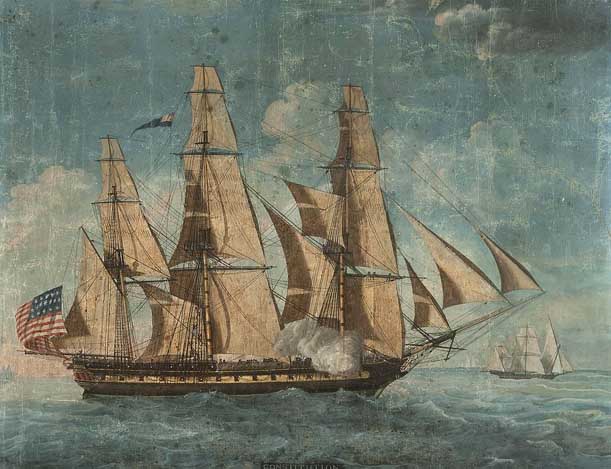
Among the dismissal causes for naval officers slightly over one-third involved alcohol abuse as the primary, or in a few cases secondary factor.6 At military installations such as Brooklyn Navy Yard, in keeping with the ideas of the time, drinks such as grog, wine and whiskey were routinely served to officers, sailors and workmen aboard ship and stationed in naval yards.7 Many of those seamen stationed at Brooklyn Navy Yard were assigned to ships in ordinary. These ships “in ordinary” were vessels held in reserve or for later need. Normally these ships, like the frigate USS Constitution 1809-1810, had seen hard service abroad and were awaiting restoration, but due to the small naval appropriations of the era, repairs were slow or not possible. Ships in ordinary typically had small or minimal crews comprised of semi-retired or disabled sailors who stayed aboard to ensure that the ship remained in usable condition, provided security, kept the bilge pump running and ensured the lines were safe. Typically, this also allowed the crew of vessels in ordinary more opportunity for liberty of leave than normal.
6. McKee p. 447.
7. Langley. Harold D., Social Reform in the United States Navy 1798-1862 (University of Illinois Press, Chicago, 1967), p. 214.
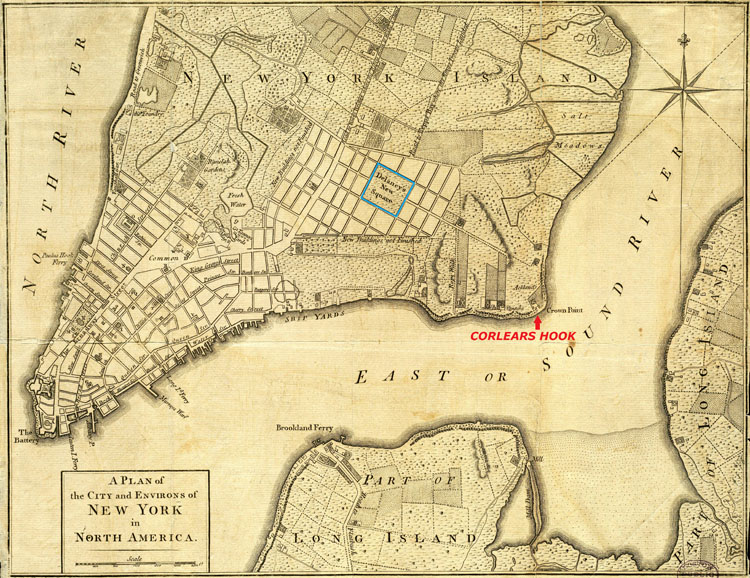
At Corlears Hook next to the shipyards, off duty sailors could readily find company in the many tavern’s dancehalls and bawdy houses.* So notorious was the Hooks reputation as a site for prostitution, that according to one theory, the local sex workers were nicknamed “Hooker” generating a new moniker for the trade.* *
* Burrows Edwin G. and Mike Wallace, Gotham a History of New York City to 1898 (Oxford University Press, New York, 1999), p. 484.
* *Barlett, John Russell Dictionary of Americanisms (Boston. Little Brown, 1859), p.201, HOOKER. A resident of the Hook, i.e. a strumpet, a sailor's trull. So called from the number of houses of ill-fame frequented by sailors at the Hook (i.e. Corlears’s Hook) in the city of New York.
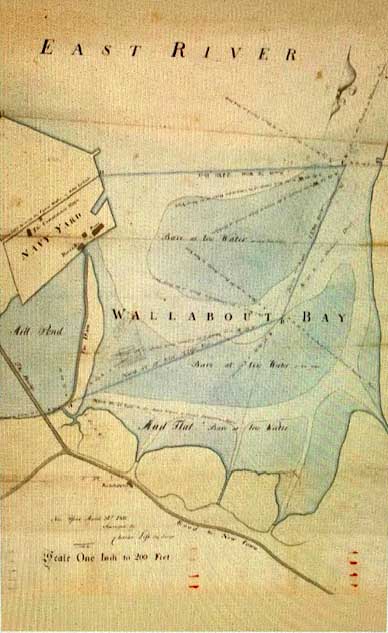
A Plan of the City and Environs of New York in North America, 1776 by Bernard Ratzer, engraved by Thomas Kitchin. Map shows both Corlears Hook and Wallabout Bay. https://digitalcollections.nypl.org/items/ed619490-c5aa-012f-7ed8-58d385a7bc34?canvasIndex=0 Public Domain
IMAGE of Wallabout BayThe area around the Brooklyn Navy Yard was a rough neighborhood. Captain Chauncey writing to the Secretary of the Navy, Robert Smith, related the dangers waiting the unwary.
On the Night of the 18th June 1809, Mr. Samuel Wares, master’s mate, took George W. Simmons, an ordinary seaman belonging to the Gun Boats in ordinary, over to town to show him where a Deserter from the Navy was secreted, which he (Simmons) pretended to have information of. Simmons took Mr. Wares up several narrow streets and alleys, at length turning suddenly upon him, he knocked him down, drew a knife and attempted to stab Mr. Wares, but in which attempt after hurting him slightly, the knife broke, he then robbed him of his watch and money and made off. I last night sent several officers and trusty men to watch his haunt and they succeeded in taking him and recovered the watch and the money. He is so hardened a villain that he says he glories in what he has done but regrets that he did not succeed in killing Mr. Ware. ***
*** Sharp John G. M. A Documentary History of the New York (Brooklyn) Navy Yard 1806-1856
The punishment for deserters like Simmons could be severe with flogging being the most common and the median number of lashes being 72!
Money was big factor, while exact figures are not available the wages of an ordinary seaman in 1805 per month were $6 – 8. Most shipyards needed skilled labor and even an unskilled day laborer could earn a dollar per day. See the Washington Navy Yard payroll for 1811.88. Sharp John G. M Washington Navy Yard Pay Rolls of Mechanics and Laborers July 1811, https://genealogytrails.com/washdc/WNY/1811payroll.html
Many sailors heartily disliked being assigned to duty on a gun boat. These small crowded ships measured about fifty feet long and eighteen feet wide, with a shallow draft for use in the shoal waters of America's harbors. They were variously rigged with oars and sails, and crewed by up to twenty men. On the plus side, if the wind failed or if they were engaged in close combat, they could be propelled by oars. Each gun boat carried two to three guns: 18 to 24-pound swivel-mounted guns or 32-pounders on traversing carriages. However, gunboats could weigh as much as seven thousand pounds, which meant that a shallow-drafted gunboat would not fare well in heavy seas. Even experienced sailors had trouble with these cumbersome vessels and nearly all had harrowing difficulties of steering a gunboat across the Atlantic.9 The war of 1812 made the administration rethink their maritime strategy with the result that the navy quickly returned many of these boats to the Brooklyn yard for storage.
9. Sharp, John G M. Nathaniel Harraden Sailing Master
http://genealogytrails.com/washdc/biographies/bio14.html
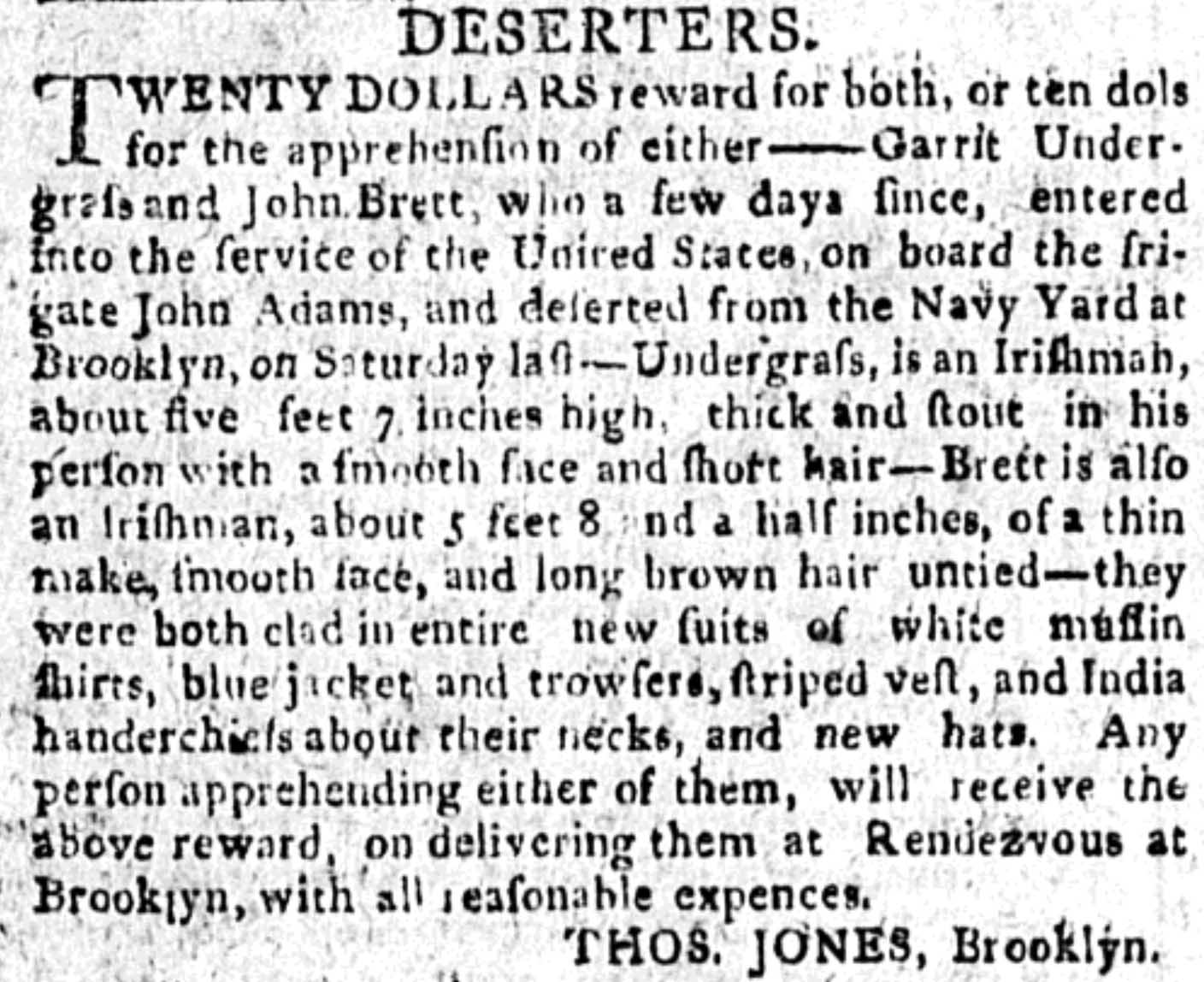
DESERTERS
TWENTY DOLLARS reward for both, or twn dols
for the apprehension of either – Garrit Under-
grass and John Brett, who a few days since, entered
into the service of the United States, on board the fri-
gate John Adams, and deserted from the Navy Yard at
Brooklyn, on Saturday last. Undergrass is an Irishman,
about 5 feet seven inches, thick and stout in his person
with a smooth face and short hair– Brett is also
an Irishman, about 5 feet 8 and a half inches, of a thin
make, smooth face and long brown hair, untied. They
were both clad in entire new suits of white muslin
shirts, blue jacket and trousers, striped vest and India
handkerchiefs about their necks, and new hats. Any
person apprehending either of them, will receive the
above reward, on delivering them at Rendezvous at
Brooklyn, with all reasonable expenses.
THOS. JONES, Brooklyn
IMAGE
New York Gazette, NY 16 May 1805
Absconded from the ? on Tuesday the
19th inst, an indented servant boy, named John
Piquerie, a native of Mule St. Nicholas island of
Hispaniola, is about 16 years old, sallow complexion,
black hair, round face, full black eyes and much mark-
ed by the small pox, speaks broken English, carries his
head down, and is rather stupid than otherwise, wore an
old snuff-colored sailor jacket and trowsers, swansdown
vest and red bandana neck hankerchief. Whoever will
return him to the subscriber shall receive twenty-five
cents reward. All persons are forbid harbouring or
? him on penalty of law
N.B. He commonly signs his name John Pack, and
will probably enter himself on board John Adams frigate.
RICHARD LAW, Jun.
No. 267 Greenwich St
March 25
U. States Gun Boat 162
Oct 30th 1810Sir,
Desertions are being very frequent of late from the Gun Boats at St. Mary’s the men being enticed away by Commanders of vessels in Florida. I have for fear there has not been a good Lookout kept, threatened to arrest the first officer that suffered a man to desert from him – In consequence of this Midshipman [Lewis S, ] Muse10 and [Arthur] Sinclair11 having lost three men and hearing of their being onboard of a ship bound out - being last night Charge of the Guard Boat - boarded the ship and took the men for which I have arrested them (the officers) and must answer to the Government for their conduct – But until I hear from my superior officer at Charlston I cannot give up the men, not feeling myself authorized to do so, the men shall be confined until I hear from the Commodore and shall give them up if ordered to do so by him.
Respectfully yours
Samuel Elbert 12U. States Gun Boat 162
Oct 30th 1810Commandant at Amelia Island
10. Muse, Lewis S. Midshipman, 11 December, 1809. Resigned 10 December, 1810.
11. Sinclair, Arthur. Lieutenant, 10 June, 1807. Master Commandant, 2 July, 1812. Captain, 24 July, 1813.
Died 7 February, 1831.12. Elbert, Samuel. Midshipman, 11 December, 1798. Lieutenant, 4 March, 1803. Died 20 December, 1812. https://www.history.navy.mil/research/library/online-reading-room/title-list-alphabetically/o/officers-continental-usnavy-mc-1775-1900.html
True Copy
Hugh G. CampbellSource: Samuel Elbert to John Rodgers 30 Oct 1810. Letters Received from Captains compiled 1805-1885,
Volume 20, 3 Sept 1810 - 31 Dec 1810. Record Group 260 NARA, Washington D.C.* * * * * *
In his letter dated 16 November 1810, Captain Isaac Chauncey (1772-1840) wrote to Secretary of the Navy, Paul Hamilton, to update him on efforts to track down and apprehend sailors who had deserted their vessels in New York harbor. Chauncey was a great organizer intelligent, direct, and a man of formidable drive and administrative skill. Chauncey was also a strict disciplinarian, renown for flogging miscreants though continually frustrated by repeated desertions.13 Although the Articles of War permitted a navy captain to award up to a dozen lashes on guilty sailor for misdemeanors such as absence without leave, or insubordination, a court martial could award more. 14, 15
13. McKee, pp. 244-245.
14. Dudley William S. Inside the US Navy of 1812-1815 Johns Hopkins University Press, (Baltimore, Maryland, 2021), pp. 252.
15. On 10 April 1806, the U.S. Congress enacted 101 Articles of War (for the Army and the Navy), which were not revised until the American Civil War.
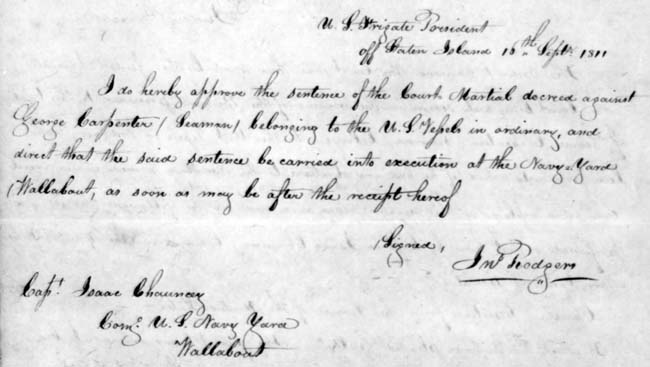
For example, Captain Chauncey directed that George Carpenter, Ordinary Seaman be tried by court martial at Brooklyn Navy Yard in Sept 1810. Carpenter was subsequently found "Guilty" of Desertion from the service of the United States … and sentenced to receive fifty lashes to be given and inflicted as such time and place as Commodore John Rodger of the United States Navy shall appoint. "The sentence of the Court Martial decreed against George Carpenter, Seaman belonging to the U.S. Vessels in ordinary, …was carried into execution at the Navy Yard (Wallabout)…" , 16, 17 Court martial, George Carpenter (O.S.) 9 Sept 1810
16. United States Navy Court Martials 1799-1867, George Carpenter, Volume 3, Case Range 75 – 119.5, Date Range Feb 16, 1810, Oct 12, 1812, NARA Washington D.C.
17. Wallabout Bay is a small body of water in Upper New York Bay along the northwest shore of the New York City borough of Brooklyn, between the present Williamsburg and Manhattan Bridges. It is located opposite Corlears Hook in Manhattan, across the East River to the west. Wallabout Bay is now the site of the Brooklyn Navy Yard.
In the case of John Wilson, a Seaman aboard the frigate USS United States then laying at Wallabout Bay, was arraigned on the following charges:
1. Desertion on [on 1 Feb.1810] from the service of the United States.
2. Striking or offering to strike a supervisor, while in the execution of the duties of his office. The charges were preferred against him by Commodore Stephen Decatur of the Navy of the United States and he subsequently pleaded "not Guilty".
During the trial of Wilson, a witness for the prosecution, acting Lieutenant John M. Funck USN18 stated that "he knows the prisoner John Wilson & sometime during the last winter in the night (he believes in the month of February) the said Wilson deserted from the U.S. Frigate Constitution then laying in a Wallabout Bay near New York."
18. Funck, John, Midshipman, 5 May, 1806. Killed in action 25 October, 1812.
Andrew Conroy (Stewart of the Frigate President) then swore he "knows the prisoner John Wilson, that he served on board the Frigate Constitution as a Seaman; and that he with another man deserted from the said Frigate about the last of January or first of February 1810, that he was marked run on the Constitution books on the first day of February 1810."
When questioned as to why he deserted, Wilson replied he had not liked being "obliged to pull off his shoes and stockings while washing the decks in cold weather which he was obliged to do by Mr. Bagot, at that time Sailing Master of the ship & during the night watches, the said Bagot, sometimes obliged him to pass up & down the rigging for four hours at a time."19, 20
19. Bagot, William F. Sailing Master, 8 June, 1804. Served on the USS Constellation and Constitution in the Mediterranean 1804 -1807, Dismissed 10 November, 1810
20. Swabbing the vessels wooden decks was done in the belief that it would dampen any gun powder that had fallen to the deck floor, thereby reduced the risk of fire.
Wilson was found Guilty of the crime of desertion with which he was charged. The prisoner then the said John Wilson was so sentenced to "pay such expenses as may have accrued in search for apprehension of him & he shall receive, one hundred lashes on his back with a cat of nine tails, at such time and place as Commodore Rodgers may direct."
Commodore John Rodgers approved the sentence on 16 January 1811and directed the same should executed on board this ship [USS President] at 9 o’clock tomorrow morning.21
21. United States Navy Court Martials 1799-1867, John Wilson, Volume 3, Case Range 75 to 119.5, Date Range Feb. 16, 1810, Oct 12, 1812, NARA Washington D.C.
Commodore Isaac Chauncey’s suggestions to the Secretary of the Navy regarding the sharing of information and the importance of descriptions of deserters and other malefactors to aide in their apprehension were never fully implemented.
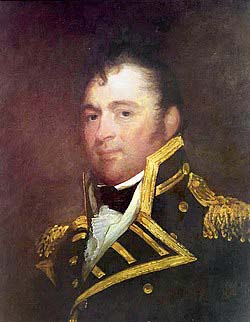
Commodore Chauncey served twice as Brooklyn Navy Yard Commandant 13 July 1807 to 16 May 1813, and again 21 December 1824 to 10 June 1833.22
22. Chauncey, Isaac. Lieutenant, 17 September, 1798. Master Commandant, 23 May, 1804. Captain, 24 April, 1806. Died 27 January, 1840. https://www.history.navy.mil/research/library/online-reading-room/title-list-alphabetically/o/officers-continental-usnavy-mc-1775-1900.html
New York Gazette 22 Feb. 1810
FIFTY DOLLARS REWARD
DESERTED from on board the U. S. ship Wasp on
Wednesday morning the 21st inst. a lad named
JAMES BUTLER, about 18 or 19 years of age, 5 feet 5
or 6 inches high, full face, sallow complexion, large blue eyes,
and thick brown hair. When he is dressed, he
appears serious and frightened; he frequently forces a
smile, which however, is only momentary, after which
the same seripusness and marks of dread pervades his
countenance. He had on when he left the ship a round
brown jacket, blue trowsers, a new black silk
hankerchief, and a fur hat about two thirds worn.
Among other things which he stole was a gold repeating
watch, capped and jeweled, and runs on a diamond,
maker's name Eardley Norton, London, No. 4301, a
patent gold chain, two large gold seals on one of which
were the letters M. G. in cypher, and a small brass
key. Any person who will apprehend the aforesaid
deserter, and deliver him on board the ship Wasp, now
lying at the Navy Yard, Brooklyn, so that the watch,
seals &c. can again be obtained by the owner, shall
receive the above reward. It is most probable that he has
gone towards Perth-Amboy as his relations principally
reside there. F22
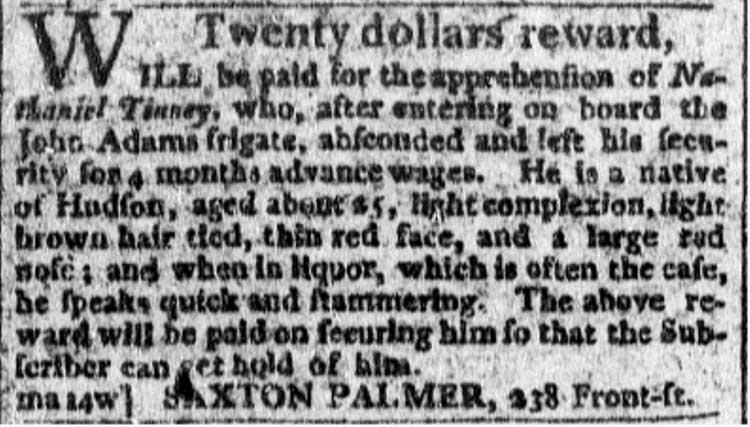
New York Public Advertiser 13 Dec 1809
TWENTY DOLLARS REWARD
WILL be paid for the apprehension of
Nathaniel Tinney, who after entering on
board the John Adams frigate, absconded and left his
security for four months advance wages. He is a native of
Hudson, aged about 25, light complexion, light brown
hair tied, thin red face, and a large red nose; and when
in liquor, which is often the case, he speaks quick and
stammering. The above reward will be paid on securing
him so that the Subscriber can get hold of him
W SAXTON PALMER, 238 Front St
IMAGE
U.S. Navy Yard New York
16th November 1810Sir,
On the 18th ult I caused to be apprehended Peter Douglas a Deserter from the U.S. Brig Argus and on the 26th Daniel Thomas, a Deserter from the Wasp in June last these two being men I have delivered to Capt. Lawrence of the Argus. On the 6th inst. I apprehended Gilbert Rowan a Deserter from the U.S. Ship Wasp in August 1809, this man I have delivered to Commodore [John] Rodgers as the senior officer on this station. Yesterday we apprehended George Carpenter (O.S.) who Deserted from the Gun Boats in Ordinary on the 17th June last. This man I shall keep in confinement until I receive your intentions upon the subject –
I take the liberty to suggest whether the publick service would not be promoted if you Sir, would direct all the commanders of our publick vessels that whenever they lost a man in whatever part of the U. States they may be into forward to me immediately a description of the Deserter when he entered, his term of service and under what circumstances he made his escape – I think passing this information very few Deserters could remain many days at this station without our discovering them as I have my Boatswain and six or eight men so well trained at that [illegible] and so well acquainted with eve part of the town where sailors resort that I am satisfied that if I was in possession of an accurate description of the men I might recover to our service two thirds of the Deserters that are about this city –I have the honor to be very Respectfully Sir, Your Obedient Humble Servant
Isaac ChaunceyThe Honorable Paul Hamilton
Secretary of the Navy
WashingtonSource:
Isaac Chauncey to Paul Hamilton 16 Nov 1810. Letter Received from Captain compiled 1805-1885. Volume 20,
3 Sept 1810 - 31 Dec 1810, Record Group 260, NARA, Washington D.C.* * * * * *
John "Jack" G. M. Sharp resides in Concord, California. He worked for the United States Navy for thirty years as a civilian personnel officer. Among his many assignments were positions in Berlin, Germany, where in 1989 he was in East Berlin the day the infamous wall was opened. He later served as Human Resources Officer in South West Asia (Bahrain). On return to the United States in 2001, he was serving on duty at the Naval District of Washington on 9/11. He has a lifelong interest in history and has written extensively on the Washington, Norfolk and Pensacola Navy Yards, labor history and the history of African Americans. His previous books include African Americans in Slavery and Freedom on the Washington Navy Yard 1799 -1865, Morgan Hannah Press 2011 and History of the Washington Navy Yard Civilian Workforce 1799-1962, 2004.
https://www.history.navy.mil/content/dam/nhhc/browse-by-topic/heritage/washington-navy-yard/pdfs/WNY_History.pdf
and the first complete transcription of the Diary of Michael Shiner Relating to the History of the Washington Navy Yard, 1813-1869, 2007/2015 online:
https://www.history.navy.mil/research/library/online-reading-room/title-list-alphabetically/d/diary-of-michael-shiner.html
His most recent work includes “Register of Patients at Naval Hospital Washington DC 1814 With The Names of American Wounded From The Battle of Bladensburg” 2018,
https://www.history.navy.mil/research/library/online-reading-room/title-list-alphabetically/r/register-patients-naval-hospital-washington-dc-1814.htmlHe is currently working as a writer/adviser with Salt Marsh Productions, Animating History American Stories Brought to Life, in a production of “The Diary of Michael Shiner” set for release late 2022.
John served on active duty in the United States Navy, including Vietnam service. He received his BA and MA in History, with honors, from San Francisco State University. He can be reached at sharpjg@yahoo.com